Showing posts with label Pentateuch. Show all posts

Saturday, October 9, 2010

Have You Subscribed to Bible Study Magazine?

The Nov/Dec issue of Bible Study Magazine is now available! Subscribe by Nov. 30 to get it. You won't regret it. I've received two issues so far, and I have to say it's the best new magazine I've seen in a long time. It's well designed, insightful about the Bible, and fun to read. And I'm not just saying that because I have articles published in the next 3 issues (starting with Nov/Dec). Here are two excerpts from my articles published in the current issue.
Hebrew Word Study
God is God, Right?
The names of God are a special case.
English translations represent God’s names in different ways—and they’re not always consistent. Sometimes the same English word is used for different Hebrew names. For example, “Lord God” can point to either Yahweh Elohim or Adonay Yahweh. Most English translations subtly represent the difference by putting the divine name Yahweh in small capitals—LORD God or Lord GOD. Using the reverse interlinear, we can find the underlying Hebrew and trace God’s name like any other.
When we do so in Genesis, we learn that God is known by His interactions with people—the God who sees (Gen 16:13), Yahweh who provides (Gen 22:14). God is often identified in Genesis by His association with Abraham, Isaac and Jacob (e.g., Gen 24:12). With each generation, He renewed His covenant and identified Himself as the same God of Israel’s ancestors. This association is how the nation of Israel related to God.
Cutting Edge
The Story You’re about to Read is True:
Anyone who thinks reading the Bible is boring has never read the story of Joseph (Gen 37–50). Filled with action, suspense, irony and intrigue, this narrative is biblical storytelling at its best. Some would say that such literary artistry smacks of fiction.1 Others consider it fictional since there is no archaeological evidence that Joseph ever existed, let alone ruled Egypt at Pharaoh’s right hand. So how does ancient history and archaeology help us understand the story of Joseph? And does the evidence point to fiction or the basis of a true story?
 Some like to use history and archaeology to prove or disprove the accuracy of the Bible. My studies in ancient history started out along those lines—seeking proof of the existence of Joseph to defend the accuracy of the Bible. Along the way, I learned that my quest for direct confirmation of the stories of Genesis was in vain, but history and archaeology consistently illuminated a plausible historical core at the center of the story. While we may never find “Joseph was here” scratched on the wall in an ancient Egyptian back alley, the Joseph story is packed with historical details that can be verified.

Sunday, July 25, 2010

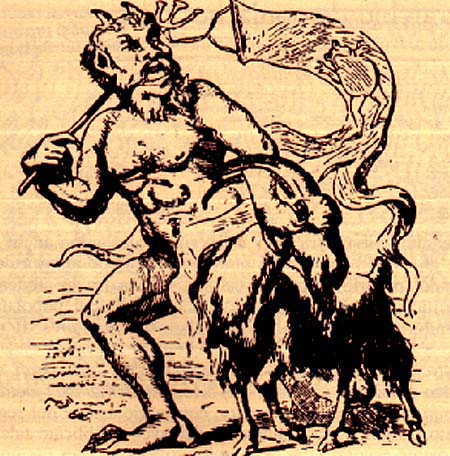
The Scapegoat Ritual in Leviticus 16

Azazel from Collin de Plancy's Dictionnaire Infernal(Paris,1825).
Leviticus 16 presents the ritual requirements for the Day of Atonement. One of the most enigmatic rituals involves the scapegoat sent off into the wilderness for “Azazel” described in Lev 16:6-10:
6 “Aaron shall offer the bull as a sin offering for himself and shall make atonement for himself and for his house. 7 Then he shall take the two goats and set them before the LORD at the entrance of the tent of meeting. 8 And Aaron shall cast lots over the two goats, one lot for the LORD and the other lot for Azazel. 9 And Aaron shall present the goat on which the lot fell for the LORD and use it as a sin offering, 10 but the goat on which the lot fell for Azazel shall be presented alive before the LORD to make atonement over it, that it may be sent away into the wilderness to Azazel.
There has been much speculation about who or what “Azazel” was: the main interpretations have been a local deity, a wilderness goat-demon, or a desert mountain. Later Jewish literature, notably the Book of Enoch, understood Azazel as a demon, one of the fallen angels and brings him into its complex mythology of supernatural angels and demons.

Rabbinic interpretation understood Azazel to be a cliff off which the goat was driven to its death.
The Rabbis, interpreting "Azazel" as "Azaz" (rugged), and "el" (strong), refer it to the rugged and rough mountain cliff from which the goat was cast down (Yoma 67b; Sifra, Ahare, ii. 2; Targ. Yer. Lev. xiv. 10, and most medieval commentators). Most modern scholars, after having for some time indorsed the old view, have accepted the opinion mysteriously hinted at by Ibn Ezra and expressly stated by Nahmanides to Lev. xvi. 8, that Azazel belongs to the class of "se'irim," goat-like demons, jinn haunting the desert, to which the Israelites were wont to offer sacrifice (Lev. xvii. 7 [A. V. "devils"] (from the Jewish Encyclopedia).
Of course, all of that may be for naught if this Hittite parallel is correct and the term is connected with a type of offering.
“In the Leviticus 16 ritual a crux has always been the term laʿazāʾzēl rendered in the Septuagint and Vulgate by “as a scapegoat” (followed by the English AV), but replaced in more recent English translations by “for Azazel,” sometimes thought to denote a wilderness demon. Appealing to scapegoat rites in the Hurrian language from the Hittite archives, Janowski and Wilhelm would derive the biblical term from a Hurrian offering term, azazḫiya. This is particularly appealing to me. There were two goats used in the Leviticus 16 ritual. One is designated for Yahweh as a “sin offering” (Heb. ḥaṭṭāʾṭ, LXX peri hamartias) (16:9), and the other is “for Azazel,” but is presented alive before Yahweh to make atonement, and is sent away into the wilderness “to/for Azazel.” The contrast is twofold: (1) Yahweh versus Azazel, and (2) sin offering versus Azazel. If one adopts the first, Azazel seems to be a divine being or demon, who must be appeased. But if one adopts the second as primary, the word ʿazāʾzēl represents the goal of the action. In the system of Hurrian offering terms to which Wilhelm’s azazḫiya belongs, the terms represent either a benefit that is sought by the offering (e.g., keldiya “for wellbeing,” cf. Heb. šelāmîm), or the central element offered (e.g., zurgiya “blood”). If Janowski and Wilhelm’s theory is correct, the Hebrew term would not denote a demon as recipient of the goat, but some benefit desired (e.g., removal of the sins and impurities) or the primary method of the offering (e.g. the banishment of the goat).”[1]
Similar rituals are widely attested in the ancient Near East with examples from Ebla and elsewhere. I'm sure much more could be said about the practice and its ancient parallels. Leviticus 16 and the term Azazel provide a fascinating example of how misunderstandings and speculation sometimes spin off into elaborate traditions that fall far from the likely original meaning of the biblical text.

Harry A. Hoffner, Jr., “Hittite-Israelite Cultural Parallels” in Hallo, W. W., & Younger, K. L. (2003). Context of Scripture, vol. 3 (xxxii). Leiden; Boston: Brill.

Friday, April 2, 2010

Written Hebrew & the Composition of the Bible

Too often our discussions of how and when the biblical books were composed fail to take into account the historical evidence for written language and text. That is, we rarely consider when the technology of writing was actually available for use composing the biblical texts. The tradition that Moses wrote the Pentateuch, for example, still has to explain how he could have written much of it in good 8th-7th century Judean Hebrew from his 13th century home in the wilderness. If Moses wrote the Pentateuch, what did he write the original in? Hebrew wasn’t an option then. Proto-Canaanite? Akkadian? Egyptian?

In recent years, a few books have come out dealing with this issue of scribal schools and scribal culture. The most well-known and influential to date have been David Carr’s Writing on the Tablet of the Heart (2005) and Karel van der Toorn’s Scribal Culture and the Making of the Hebrew Bible (2007).

sanders inv of Heb But the book that I think best deals with the question of how, why, and when the Israelites started writing Hebrew and how that impacts our theories of biblical composition is The Invention of Hebrew by Seth L. Sanders (2009). Perhaps the fact that Sanders provides theoretical and evidential support for some of what I’ve already long suspected about biblical Hebrew and the composition of the Hebrew Bible makes his argument land persuasively on me, but I will be very surprised if this book doesn’t have a major impact on future studies exploring the composition of particular biblical books. It is, in my opinion, a game-changer. Here is a representative quote:

By 700 B.C.E. local scripts like Hebrew have escaped the royal chancery; Israelites have used the old linear alphabet to create a literature. In the late Iron Age we find extended linear alphabetic texts in a spectrum of genres: letters from all walks of life, poetry, and ritual blessings. In the kingdoms of Israel and Judah the new writing had assumed a definitive status. Yet in the very territory and history Hebrew described, the literary silence from which it emerged had been forgotten.

The most successful product of this new writing, the Bible[,] reads as if written Hebrew had always existed, preserving no memory of its origins or what came before it. From the beginning, God had written the language that He, and Israel, spoke: Hebrew. Memory has been a major theme of recent Bible scholarship that tries to reconcile Near Eastern history with biblical literature. But the Bible was also a powerful tool for forgetting: the gap in memory between Late Bronze Age and late Iron Age culture erases a decisive moment in the history of writing in Israel, the point at which written Hebrew was invented. (p. 80)

Disclosure of Material Connection:  I have a material connection because I received a review copy (book, CD, software, etc.), or an item of nominal value that I can keep for consideration in preparing to write this content. This is not a full book review, but to be safe, I wanted to acknowledge the connection. Thanks to University of Illinois Press for sending along a copy of this book.

Friday, December 4, 2009

In the Mail: The Right Chorale


LEVINSON, BERNARD M.
"The Right Chorale": Studies in Biblical Law and Interpretation
2008. XXIII, 432 pages. plus 34 figures. FAT 54
ISBN 978-3-16-149382-9
cloth € 99.00

Thanks to the kind folks at Mohr Siebeck who sent along a copy of Bernard Levinson's recent book, "The Right Chorale": Studies in Biblical Law and Interpretation. It looks excellent, and I simply must come up with an excuse to read it sooner, rather than later. I will, of course, review it in depth here in the coming months. For now, here's the publisher's description:
This book presents twelve selected investigations of textual composition, interpretation, revision, and transmission. With these studies, Bernard Levinson draws upon the literary forebears of biblical law in cuneiform literature and its reinterpretation in the Second Temple period to provide the horizon of ancient Israelite legal exegesis. The volume makes a sustained argument about the nature of textuality in ancient Israel: Israelite scribes were sophisticated readers, authors, and thinkers who were conscious of their place in literary and intellectual history, even as they sought to renew and transform their cultural patrimony in significant ways. Originally published over a decade and a half, the significantly revised and updated studies gathered here explore the connections between law and narrative, show the close connections between Deuteronomy and the Neo-Assyrian loyalty oath tradition, address the literary relationship of Deuteronomy and the Covenant Code, reflect upon important questions of methodology, and explore the contributions of the Bible to later western intellectual history. The volume offers essential reading for an understanding of the Pentateuch and biblical law.