Showing posts with label Ancient Judaism. Show all posts

Friday, May 13, 2011

Food and Identity in Early Rabbinic Judaism


I was waiting with bated breath for my friend Jordan Rosenblum's book to be published by Cambridge, but then it was, and I forgot til now to mention it. 


Now a very informative review of the book Food and Identity in Early Rabbinic Judaism has been posted on H-Judaic, so you can learn more about the book before deciding if you want to spend 50 pounds on it (that's UK currency - I don't think the book will help you lose weight). From the review:
Following decades of excitement over new social scientific methodologies in the study of religion, more recent scholars have asked why the new insights offered by these models so often appear inadequate. Jordan Rosenblum provides one answer by actively embracing anthropological innovations in the study of early rabbinic food practices, while simultaneously insisting on a different data set. He observes that previous treatments have elided biblical law and Jewish identity, overlooking the great changes that rabbinic texts made to the food (and other) practices that have shaped later Judaisms. Asserting the necessity of his own investigation of food and identity in early Judaism, he demonstrates that crucial, anthropological approaches have not been adequate for the consideration of rabbinic sources because the questions most frequently posed have not engaged available evidence. In reply to famous early explorations of Roland Barthes, Mary Douglas, and more recently Marvin Harris, Rosenblum argues that “the absolute origins of the prohibitions against pork, for example, are irrelevant. What matters for the Tannaim is that God instituted the ban in the Hebrew Bible. How they interpret, understand, and enact this regulation is verifiable” (p. 9). He promises a book that presents the appropriate data set, as well as the best tools and models for considering how the preparation and ingestion of food constructs identity.
If you read the rest of Susan Marks' review, you will indeed want to read the book. And I'm not just saying that because Rosenblum taught me to read rabbinic Hebrew.

Saturday, March 5, 2011

Scripting Jesus

I had a irresistible bookstore coupon good only this weekend, so I trekked to the nearest Borders to see what they had that might be of interest to me. My interests range far and wide in religious studies and theology, but aside from Hebrew Bible and translation studies, my main trajectory of research interest is Judaism and Christianity in Late Antiquity. That covers Second Temple Judaism, New Testament, and rabbinics (for starters). To expand my horizons in Gospels and Jesus research, I decided to get L. Michael White's book Scripting Jesus: The Gospels in Rewrite. The differences between the Gospels have always fascinated me, and this book looks like a great treatment of the issue. If you've read it, let me know what you thought.

From the publisher:
In Scripting Jesus, famed scholar of early Christianity L. Michael White challenges us to read the gospels as they were originally intended—as performed stories of faith rather than factual histories. White demonstrates that each of the four gospel writers had a specific audience in mind and a specific theological agenda to push, and consequently wrote and rewrote their lives of Jesus accordingly—in effect,scripting Jesus to get a particular point across and to achieve the desired audience reaction. 
The gospel stories have shaped the beliefs of almost two and a half billion Christians. But the gospel writers were not reporters—rather, they were dramatists, and the stories they told publicly about Jesus were edited and reedited for the greatest effect. Understanding how these first-century Christians wanted to present Jesus offers us a way to make sense of the sometimes conflicting stories in the gospels. 
One gospel's version of events will be at odds with another. For instance, in Jesus's birth narrative, there is no mention of a stable in Matthew or Luke, but then there are no wise men in Luke and no shepherds in Matthew. Jesus has brothers in some gospel accounts, and sisters in others, and their naming is inconsistent. Depending on which gospel you are reading, the disciples shift from bumbling morons to heroes of faith. Miracles alter or disappear altogether, and whole scenes get moved around. Such changes from one gospel to the next reveal the shaping and reshaping of the basic story in the living world of the first followers of Jesus. 
With his usual engaging style, White helps us read the gospels with fresh eyes, giving us a clearer idea of what the gospel stories meant to people in ancient times, and offering insight for how we can understand Jesus's story today.

Tuesday, February 1, 2011

Interested in Talmud?

If so, you may also find this article from Jewish Ideas Daily fascinating. I think it's a great brief intro into what rabbinics scholars actually do - (same as the rest of us studying ancient texts: weave theories of origin, identity, and interpretation from close reading of texts). My interest is more in Tannaitic literature, specifically midrash, but that's just because the deep rabbit hole of Talmud scares me. Here are a few excerpts.
The traditional "back story" of the Talmud is put forth in the 10th-century "Epistle" of the great Babylonian scholar Sherira Gaon. It is an invaluable source for reconstructing the generations of sages and students, and the chains of transmission, that yielded the Mishnah and Gemara, which in turn, and together, make up the Talmud. Yet many questions are left unanswered by Sherira. When and how were the Mishnah and Gemara, both of which were Oral Torah, written down? What exactly was the role of the post-talmudic Savoraim, the "explainers" who, Sherira says, "rendered interpretations akin to judgments"?
Epstein and others (including Abraham Weiss and Hyman Klein) gained purchase on these questions by investigating the relationship among the three basic historical layers of which the Talmud is composed: sources associated with the sages known as Tannaim, dating from before and up to the composition of the Mishnah at the turn of the 3rd century; the many statements and discussions attributed by name to the Amoraim, sages coming after the Mishnah; and the anonymous editorial voice known as "the stam" (literally, "plain voice") in which the first two layers are embedded and which surrounds, organizes, and discusses them.
The finished Talmud weaves all of these fragmentary traditions and texts into coherent dialogues among sages living miles and centuries apart, regularly transposing and reformulating sources while adding a sophisticated apparatus of explanation. The result is a work that not only is intellectually compelling but regularly achieves powerful literary effects. To Epstein and the others, what became increasingly clear was that strong editorial hands had been at play in the process.
[...]
This portrait of rabbinic culture begets, in turn, a powerful challenge. Modern intellectual integrity having yielded a restless scenario of fragmentary ancient texts being worked and reworked into the sources we have today, can we somehow put the pieces back together into a coherent and compelling story? And will that story reflect not only the work of the rabbinic interpreters but also the original texts and traditions, by now lost to us, that they were trying, through their editing, to maintain? 
The answer is yes, but it will be a different story, in ways both stranger and more familiar: a story of internal ferment and spiritual survival in the face of profound uncertainty.

Saturday, October 23, 2010

Oxford Handbook of the Dead Sea Scrolls

Forthcoming from Oxford University Press - The Oxford Handbook of the Dead Sea Scrolls edited by Timothy Lim and John Collins. With a Dec 2010 publishing date, it should come out just in time for a late Christmas present for myself. I've been looking forward to this volume since first hearing about it from one of the contributors a couple of years ago. I'm impressed by the wide variety of perspectives represented by the 30 contributors. Most of the chapters address issues of Dead Sea Scrolls research that have long interested me such as the origins of the movement, the fascination with a solar calendar, and shared exegetical trajectories pointing toward rabbinic and early Christian literature.

The purpose behind the volume is described as follows.
It seeks to probe the main disputed issues in the study of the Scrolls. Lively debate continues over the archaeology and history of the site, the nature and identity of the sect, and its relation to the broader world of Second Temple Judaism and to later Jewish and Christian tradition. It is the Handbook's intention here to reflect on diverse opinions and viewpoints, highlight the points of disagreement, and point to promising directions for future research.
The Full Table of Contents can be found on OUP's website.

Now, where to find $150.00 for one book?

HT: Agade

Tuesday, October 19, 2010

Dilettante Access to the Dead Sea Scrolls

In a move that has DSS dilettantes everywhere bursting with excitement, the Israel Antiquities Authority has announced a partnership with Google to bring their archive of DSS fragments online in high resolution images.

The contents and origin of the DSS have been the source of decades of speculation for conspiracy theorists (and scholars) who just really really really wanted to know what the Scrolls said. Despite the fact that virtually everything has finally been officially published, a few dedicated crackpots continue to comb through the contents for clues to support their crazy theories linking Christianity to the DSS sect.

Now those crazy crackpots can go ahead and learn ancient Hebrew and decipher the scrolls for themselves once the collection is put online for everyone to see. It is indeed a great day for dilettante Qumran specialists.

But seriously, this is part of a larger effort by the IAA to preserve the scrolls which are becoming increasingly difficult to read due to decades of handling, light exposure, and poor preservation techniques. Transparency of the contents and free access are side benefits of the greater goal - making such high quality images that the image can take the place of the original for scholarly access. Well done, IAA. Keep up the good work!
"This is the ultimate image of the scroll you can get get," explained IAA project manager Pnina Shor, as she showed reporters an example of the imaging. "It presents an authentic copy of the scroll, that once online, there is no need to expose the scrolls anymore."
...
"We have succeeded in recruiting the best minds and technological means to preserve this unrivalled cultural heritage treasure, which belongs to all of us, so that the public, with a click of the mouse, will be able to access history in its fullest glamour," [IAA General Director Shuka] Dorfman said. (Via CNN)
HT: Agade mailing list w/ link to ABC News.

Sunday, September 26, 2010

Now in Paperback! Best Book on Inner-Biblical Exegesis Ever!

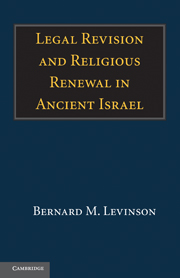
About a year and a half ago, I reviewed Bernard Levinson's book Legal Revision and Religious Renewal in Ancient Israel. I'm pleased to announce that this thought-provoking volume is now available in an affordable paperback edition. My hope is that it will reach a wider audience in biblical studies, especially graduate students interested in the formation of the Hebrew Bible and inner-biblical exegesis. Here are some of the published reactions highlighted by the publisher.
"This would be an excellent addition to any theological library and it is to be hoped that the publisher will soon release a paperback version so more students can enjoy the fruits of Levinson’s labours. —Theological Book Review 21 (2009)
“With this study Levinson demonstrates again how he masterfully integrates his own exegetical brilliance into larger theoretical frameworks beyond the constraints of biblical studies.” —Journal of Ancient Judaism
“The book deserves a wide readership. It would serve well as a text for advanced undergraduate or graduate courses that deal with inner-biblical exegesis. One can also hope that scholars in other fields will read it and take to heart Levinson’s argument for the reintegration of biblical studies into the core of academic work in the humanities. The book’s research is thorough, its argument forceful, its writing elegant, and it is blessedly short. If books can be placed into tribes, may this one’s increase.”—Review of Biblical Literature
“Perhaps I am biased, but it seems to me to be beyond any reasonable doubt that, behind the final form of the canonical, biblical text lies evidence of a lively, imaginative, and creative use of interpretation, reinterpretation, and reapplication of earlier texts. It is a complex, living, creative achievement which, for just this reason, invites constant, continuing invention, as Levinson maintains. I certainly find this book itself a delightful, informative, and stimulating one to read.” —Journal of Theological Studies

Monday, August 16, 2010

Terminology Pet-Peeve: Israelites and Jews

The Jews, as a people, come into existence after the return from exile in Babylon in c. 539 BCE. Before that, they are Judahites and Israelites. It's an easy distinction to miss, but there IS a difference. I've heard the ancient Israelites referred to as Jews a few times lately from pulpits (I listen to podcast sermons, not just my local pulpit, so no indirect finger pointing). The "Jews" did not leave Egypt with Moses, conquer Canaan, and establish the kingdom of Israel. (I realize Jewish tradition, esp. the Passover haggadah, links ALL Jews to the experience of Exodus. That's a theological issue, not a historical one.)

After the kingdom splits in two (under Rehoboam, Solomon's inept son), the two kingdoms are Israel and Judah. The inhabitants of the northern kingdom were Israelites, not Jews. The inhabitants of the southern kingdom were Judahites. Both peoples are ancestors of the Jews. After the northern kingdom was taken into exile in 722 BCE, the southern kingdom received a large population bump, so Judah under Hezekiah and the following kings until the exile probably included tribes of Israel and Judah together.

If you're reading Ezra, Nehemiah, Esther, or the New Testament, the people are Jews. If you're reading the books of Samuel, Kings, or most of the prophets, they're not Jews. Better to refer to them as Israelites when unified or in reference to the northern kingdom (Elijah was a northern prophet, for example). Referring to the people of the southern kingdom as "Jews" would be marginally acceptable. For a good discussion of the transition from Israelite to Jew, listen to Michael Satlow's podcast series "From Israelite to Jew" found on his blog or through iTunes.

Saturday, August 14, 2010

Honorable Mentions: Historical or Literary?

Back in 2008, I wrote a post dealing with the issue of whether the New Testament references to Old Testament characters can be taken as evidence for their historicity. My conclusion was that, in general, the NT writers were referring to the characters known from Jewish literature and not trying to claim historicity. I don’t believe they were concerned with those types of questions. It may have been assumed, but it didn’t matter for their theological point whether Jonah or Job really lived. What mattered was the story and the example it provided.

Before I go any further, I need to clarify that I am not questioning the real historical existence of all biblical characters. I am also not reducing the Bible to the level of pure fiction. T.C. recently questioned that ambiguity in my previous post, so I want to be clear. I believe archaeology provides strong circumstantial evidence for the existence of certain biblical people, like David, for example. The best explanation of the Tel Dan inscription is that it refers to a real Davidic dynasty. Certain biblical characters like Abraham, Moses, Aaron, Joshua, David, and Solomon are central to the story of salvation history. I’m not questioning their existence, even though I can’t prove it definitively.

The issue is whether an “honorable mention” by another biblical writer is a reference to a historical person or a literary figure. The default position seems to be to take the reference historically. Earlier I dealt with NT references to OT characters, but what about OT references to other characters?

A few days ago Jeff posted “Was Job a Real Person?” His answer:  “Of course he was!” with appeal to Ezek 14:14 for confirmation.
I realize that Ezekiel is filled with dream-like imagery, but this message from the Lord (and the rest of the section) certainly confirms to me that they were real individuals. Not that I needed any more convincing.
I’m not criticizing Jeff’s conclusion. It is a valid answer to the question, but I don’t think it’s the only reasonable answer. A commenter on his post also drew in James 5:11 to support Job’s existence and commented how he believed Jonah historical as well for similar reasons. But why jump to conclusions? Why assume the biblical writer meant to allude to a historical personage? As a 21st century reader, do you follow the reference because it’s historical or because you know the literary text that it alludes to? That’s easy . . . you know the text. You know the story.

Let’s look closer at the references in Ezekiel 14:14 (repeated in v. 20).
even if these three men, Noah, Daniel[1], and Job, were in it, they would deliver but their own lives by their righteousness, declares the Lord GOD.
Commentators often take this as a reference to 3 non-Israelite “saints.”[2] The non-Israelite identity is important for the larger theme of general or universal retribution in Ezekiel 14.  The connection of righteousness or virtue with these three is also key. Gen 6:9 reads “These are the generations of Noah. Noah was a righteous man, blameless in his generation. Noah walked with God.” Job 1:1 says “There was a man in the land of Uz whose name was Job, and that man was blameless and upright, one who feared God and turned away from evil.” Noah and Job are clearly held up as ideal paragons of virtue. (More to come on "Daniel.") Their righteousness is known not from history but from literature. Does the point of v. 14 require their stories to have actually happened or does it simply require one knows the story - much like a parable teaches a point?

The details given about Job’s status, wealth and family don’t prove the story is not a parable or folk tale. We don’t know where the land of Uz is. Job is identified by his character, not his patronymic (that is, no “son of SO & SO” to give a family identification). The circumstances of his suffering and restoration have all the ring of the classic West Semitic epics like Aqhat or Kirta. The fact that the reference to “Daniel” is almost certainly to a character from a non-biblical West Semitic epic further strengthens the conclusion that Job and Noah are evoked here for their literary significance, not their historical existence. (Was there a historical Noah and a worldwide flood? Still thinking that through, but I knew you’d ask.)

Acknowledging that some OT characters, like Jonah[3]  and Job, might simply be literary figures with no historical existence in no way undermines the accuracy or inerrancy of the biblical text. The issue is with the reader, not the text. The reader is demanding something of the text it never intended to give. Searching for a historical Job is, in my mind, about as likely to turn up solid results as a quest for the historical Prodigal Son (Luke 15).

Comments and discussion are welcome. My thoughts on this issue are continually in process.

[1] Daniel in this text presents a special problem that I’ll address in another post.
[2] See Leslie C. Allen, Ezekiel 1-19, WBC, and Moshe Greenberg, Ezekiel 1-20, AYB.
[3] Jonah, of course, was known from the historical books - 2 Kgs 14:25. But his literary fame comes from the book of Jonah and his fish story - a story, IMO, borrowing the character of an otherwise little known prophet.

Friday, August 13, 2010

Michael Wise Interview - Minnesota DSS Exhibit

Michael Wise
Michael Wise, master of ancient languages and my first Hebrew and Latin teacher, was interviewed by The Catholic Spirit about the Minnesota Dead Sea Scrolls Exhibit (reviewed here). If you haven't yet had a chance to see the exhibit, I highly recommend it, and this interview is a good introduction on what you can expect to get out of it. Here are a few quotes:

What would you recommend that visitors take more time viewing?

There’s a portion of the exhibit given over to explaining how scribal processes work. I think it’s important for people to spend more time looking at that.
We just don’t understand how differently book culture worked in the ancient world compared to how it works today.    . . . We don’t understand how texts got made and how they got passed on. It’s well explained in the exhibit. . . .

[...]

What do you think the scrolls prove about Christianity?
My own view of Christianity is that it can’t be proven or disproved by archaeology. Every artifact we uncover . . . always requires interpretation. It’s at the sifting level that people of faith or people who want to argue against faith can always find some kind of grist for their mill. . . . The texts can’t prove Chris tia nity. Can they prove that the things we’re told about Christianity and Judaism in the Bible really were being said 2,000 years ago? Yes, they can prove that. . . .
Before the discovery of the Dead Sea Scrolls, we couldn’t prove, in a scientific sense of having tangible evidence, that the Bible was any older than about 1,000 or 1,200 AD. . . . Today, we can say these texts show us that the Bible is as old as the time of Jesus and more . . . there is evidence, scientifically.

Photo via The Catholic Spirit

HT: Jim Davila

Saturday, July 31, 2010

In the Mail: Elijah and the Rabbis

Today I received a review copy from Columbia University Press of Elijah and the Rabbis: Story and Theology by Kristen H. Lindbeck.

From the publisher:

Through an innovative synthesis of narrative critique, oral-formulaic study, folkloric research, and literary analysis, Kristen H. Lindbeck reads all the Elijah narratives in the Babylonian Talmud and details the rise of a distinct, quasi-angelic figure who takes pleasure in ordinary interaction.

During the Talmudic period of 50-500 C.E., Elijah developed into a recognizable character quite different from the Elijah of the Bible. The Elijah of the Talmud dispenses wisdom, advice, and, like the Elijah of Jewish folklore, helps people directly, even with material gifts. Lindbeck highlights particular features of the Elijah stories, allowing them to be grouped into generic categories and considered alongside Rabbinic literary motifs and non-Jewish traditions of late antiquity. She compares Elijah in the Babylonian Talmud to a range of characters—angels, rabbis, wonder-workers, the angel of death, Christian saints, and even the Greek god Hermes. She concludes with a survey of Elijah's diverse roles from medieval times to today, throwing into brilliant relief the complex relationship between ancient Elijah traditions and later folktales and liturgy that show Elijah bringing benefits and blessings, appearing at circumcisions and Passover, and visiting households after the Sabbath.

I find the development of biblical figures in later religious traditions to be a fascinating subject. I look forward to reading it and offering more of a review here in the future.

Wednesday, July 28, 2010

Understatement of the Day

The understatement of the day comes from National Geographic News in an article about their upcoming documentary on the Dead Sea Scrolls. It sums up almost all research ever on the DSS.
"I have a feeling it's going to be very disputed," said Lawrence Schiffman, a professor of Hebrew and Judaic Studies at New York University (NYU).
The article places this quote in response to Bob Cargill's comments:
"Jews wrote the Scrolls, but it may not have been just one specific group. It could have been groups of different Jews," said Robert Cargill, an archaeologist who appears in the documentary Writing the Dead Sea Scrolls, which airs Tuesday at 9 p.m. ET/PT on the National Geographic Channel.
I agree with Bob and I think the new consensus is moving more in this direction in regard to the origins of the scrolls. Of course, almost everything's been disputed in Qumran research. I wish I got cable so I could watch the documentary. Oh well . . .

Monday, June 7, 2010

Beyond the Qumran Community

John J. Collins
Beyond the Qumran Community: The Sectarian Movement of the Dead Sea Scrolls.
Wm. B. Eerdmans, 2010

A few months ago, I was convinced that the Essenes had no clear connection to the Dead Sea Scrolls and that the site of Qumran was most likely not a religious sectarian settlement. (Background here.) Now I’m not totally recanting my earlier skepticism, but after reading John Collins’s latest book, I’ve realized my hard-line denial of the possibility was clouding my objectivity and hindering my understanding of consensus arguments. Yes, many of the consensus positions require a speculative leap at some point to bring evidence and theory together, but the connections are not as completely implausible as I’d thought. Since I value going where the evidence leads more than defending a particular point of view, I have to admit that Collins has done a fine job in presenting the most nuanced and balanced account of the Qumran sect that I have ever read.

The material is organized in 5 chapters:

1. The New Covenant. The community described in the Damascus Document (CD) is discussed in depth. The laws and the distinctive elements about sectarian life are compared with evidence from other sectarian documents like 4QMMT and other Jewish literature from the period such as Enoch and Jubilees.

2. The Yaḥad. The sectarian community described in the Community Rule (1QS) is compared with that in the Damascus Document. The surprising conclusion (that seems obvious once it has been presented) is that they do NOT describe the same group. This is important because most scholarship on the DSS sect takes all sectarian texts together as describing a single sect that dwelled at Qumran.

3. The Historical Context. Here Collins reviews the evidence for the historical setting of the sectarian movement. Consensus had previously placed the origins of the sect in the early 2nd century BCE (i.e., Jonathan Maccabee was the Wicked Priest). I have long found the arguments for a 1st century BCE setting compelling especially as laid out by M.O. Wise (“Dating the Teacher of Righteousness and the Floruit of His Movement,” JBL 122 (2003):53-87). Collins points out how the pillars that had supported a 2nd century dating have eroded as a result of recent research.

4. The Essenes. Much scholarship on Qumran and the sect described in the DSS ignores or minimizes the contributions from scholars such as N. Golb. The fact that Collins will at least mention Golb and cite him when appropriate is surely a sign of his respect for hearing all sides in the debate. The Essene hypothesis identifying the sect described in the scrolls with the Essenes described by Josephus and other ancient writers has been one of the most controversial issues in DSS scholarship. Collins treats all sides fairly and accurately represents the strengths and weaknesses of each argument. His chapter lays out the problem and the possible solutions clearly without overtly favoring one side until all the options and evidence have been discussed. It is typical of Collins in this book to avoid coloring the reader’s perceptions of the issue by giving away his preferred interpretation up front.

5. The Site of Qumran. In this final chapter, Collins discusses the archaeology of Qumran and the possible connection between the site and the scrolls. He gives a full account of the major interpretations of the site and concludes that at least in the final period of settlement before the First Revolt in 66-68 CE, the site likely housed a sectarian settlement. However, he believes the group at Qumran was small and one of many settlements of the sect described in the scrolls. This theory explains the data much better than claiming a single large sect lived at or near Qumran and composed all the scrolls. It allows for many of the scrolls to be brought from elsewhere during the upheaval of the First Revolt. It also explains the multiplicity of sectarian documents such as different copies of the Community Rule that differ slightly. Other theories such as Golb’s idea that the collection of scrolls came from a Jerusalem Temple archive hidden in the area have trouble with the fact that the library lacks the diversity often attributed to Second Temple Judaism. Where are the Sadducean texts if this was a temple archive? Where are the scrolls written by the Pharisees?  The theory that these scrolls were brought together by members of one larger group makes better sense. It explains the fact that most of the sectarian literature has an overarching unity (i.e., calendrical and purity issues) that fits with the larger parent group and a diversity (i.e., celibate or married) that can be explained by the subgroups.

I am still not convinced that the scrolls found in 11 caves near the Dead Sea are necessarily connected to anyone who inhabited Qumran or to the Essenes. However, Collins has convinced me that the consensus is not totally implausible. The straightforward way that he engages and deconstructs consensus and non-consensus scholars alike shows me that he is more concerned with giving an honest interpretation of the evidence than defending any theory in particular. His careful method of debunking mistaken assumptions and conclusions on all sides is a quality I admire, not least because I felt that I would have approached the problem in much the same way.

The book is well worth reading and quite affordable at $25 paperback. If/when I teach an introductory class on the Dead Sea Scrolls, this will be required reading. The bibliography is substantial and Collins’s familiarity with the immense secondary literature on the DSS is a model of good scholarship.

To close, as required in book review posts now, I must disclose that I have NO material connection to the publisher. Yes, that’s right. I did not receive a free review copy for saying nice things about the book. I actually bought this book for myself and found his treatment of the issues so compelling that I was compelled to recommend the book to all of you.

Saturday, April 24, 2010

The Minnesota Dead Sea Scrolls Exhibit

scrolls-300x250 I had the opportunity a couple of weeks ago to see the Dead Sea Scrolls exhibit at the Science Museum of Minnesota in St. Paul. Last week, I viewed the Dead Sea Scrolls and the Bible exhibit at the Milwaukee Public Museum. Counting my trip to the San Diego exhibit in 2007, I have now had the “once-in-a-lifetime” opportunity to see the scrolls three times. The Minnesota exhibit’s advertising urges you to:
Experience a once-in-a-lifetime opportunity to witness one of the greatest archaeological finds of the 20th century—the Dead Sea Scrolls, which include the earliest known Biblical writings.
I will comment on the Milwaukee exhibit in a separate post. For a much more thorough review than I intend to do, see John’s post here.

If you are in the Twin Cities any time between now and October 24th, I highly recommend you take a few hours to go see the exhibit at the Science Museum. Of the three exhibits I’ve seen, the scope of the MN exhibit is the most comprehensive in terms of background information related to the Scrolls and the site of Qumran. I’m more familiar than the average person with the various theories and debates related to the DSS, and the main thing that impressed me about the MN exhibit was how it laid out all the options related to the identity of the sect and the possible uses of the site without privileging any particular angle. The exhibit does not play up a simplistic either/or dichotomy of Jerusalem origins vs. Qumran Essene origin that might have been assumed from some of the media coverage. While past exhibits have mentioned the existence of multiple theories, this is the only one I’ve seen that incorporates the information on multiple theories throughout the exhibit and doesn’t “spin” the evidence in favor of any particular perspective. (Concerning the San Diego exhibit, Bob Cargill pointed out that his documentary at the exhibit laid out the options. While that may be so, I saw the exhibit but not the movie and the exhibit itself was very much oriented toward the “Standard Hypothesis” of Qumran Essene origin for the scrolls.)

Now I have a theory for why museums and other popular presentations of controversial issues like this present one theory as stronger and more certain than it really is. People like certainty and proof (just ask Scott). They’re uncomfortable with uncertainty, ambiguity, and tension between competing interpretations. They also don’t like to think for themselves. So while multiple theories and raw data might be presented, they’re usually told which one is the “right” answer. Not so at the MN exhibit. All the options are laid out and you’re left to decide for yourself who makes a stronger case. (In case you want someone to tell you what to think: The scrolls were not composed at Qumran by a monk-like group of Essenes. Pick any other theory and it makes more sense of the data.)

The flow of the exhibit works well and the free audio tour was a definite plus. (The Milwaukee exhibit charges an extra $6 for an audio tour which I did not purchase.) Most of your time at the exhibit won’t be spent in the Scrolls room. There are only 5 scrolls on display at a time at the Science Museum. But the Scrolls display is really just the climax to a very comprehensive exhibit of artifacts from Second Temple Judaism and the archaeology of the Dead Sea region. One of my favorite parts of the exhibit was on how Israel is working now to preserve the scroll fragments, contrasting current methods of preservation with the “what-were-they-thinking” techniques from the 1950s (involving scotch tape, plate glass, and cigarettes – you can see the plate glass and the tape still in use on the DSS fragments displayed in Milwaukee).

As an added bonus, 28 pages of the Saint John’s Bible are on display in an additional exhibit at the end of the DSS exhibit. The Saint John’s Bible is a hand-written illuminated Bible, the first of its kind since the invention of the printing press. Scribal culture is getting a mini-revival of sorts! The artwork and script is amazing and well worth seeing.

If you get the opportunity, the Dead Sea Scrolls exhibit at the Science Museum of Minnesota is well worth the trip. It’s a once-in-a-lifetime opportunity!

Thursday, April 8, 2010

Sad News: The Passing of Hanan Eshel

Hanan Eshel, known best to me as author of The Dead Sea Scrolls and the Hasmonean State, has passed away today.

His book was a very good synthesis attempting to place the DSS in a wider historical context. His scholarship on Second Temple Judaism was top notch. He will be missed.

My condolences to his family and friends.

The news of his passing was reported here, among other places.

Saturday, April 3, 2010

Introducing Mekhilta de-Rabbi Ishmael

Continuing my occasional journey through rabbinic literature, I want to introduce readers to my all-time favorite collection of midrash – Mekhilta de-Rabbi Ishmael (hereafter “Mekhilta” though there is another lesser known Mekhilta de-R. Simeon ben Yoḥai). Admittedly, my experience with rabbinic literature is limited, so my favoritism for Mekhilta might be based merely on familiarity. It is also possible that my preference is colored by Boyarin's use of Mekhilta for his case studies in Intertextuality and the Reading of Midrash, the book that first introduced me to reading rabbinic interpretation.

Mekhilta is one of the halakhic midrashim. The name itself “Mekhilta” is an Aramaic word meaning “rule” or “norm.” It is used in the Talmud to designate not the commentary specifically but general notes on halakhic exegesis and the rules guiding that exegesis (ITM, 252). This is common in rabbinics - “midrash” can refer to a book like Mekhilta or simply to an exegetical method; “mishnah” can refer to the Mishnah or to a particular law/section in the Mishnah. The Mekhilta is named after R. Ishmael, the first authority named in Pisḥa 2. The exegesis covers Exodus 12:1-23:19; 31:12-17; and 35:1-3 (ibid.). As with much rabbinic literature, pinning down a precise date of composition is difficult. It is one of the tannaitic midrashim, containing early rabbinic traditions and exegesis. It was probably redacted sometime in the late 3rd century or 4th century C.E. in Palestine.

The Hebrew text below is from Lauterbach's edition. The English translation is mine.

Pisḥa 1, Parashah 1, lines 1-10.


ויאמר יי אל משה ואל אהרן בארץ מצרים לאמר שומע אני שהיה הדיבור למשה ולאהרן כשהוא אומר ויהי ביום דבר יי אל משה בארץ מצרים למשה היה הדיבור ולא היה הדיבור לאהרן אם כן מה תלמוד לומר אל משה ואל אהרן אלא מלמד שכשם שהיה משה כלול לדברות כך היה אהרן כלול לדברות ומפני מה לא נדבר עמו מפני כבודו של משה נמצאת ממעט את אהרן מכל הדברות שבתורה חוץ משלשה מקומות מפני שאי איפשר׃
Translation
“And the Lord said to Moses and Aaron in the land of Egypt, saying” (Exod. 12:1). I could understand that the divine revelation (הדיבור; Jastrow, 295) was for Moses and for Aaron. But when it says, “And it came to pass on the day when the Lord spoke to Moses in the land of Egypt” (Exod. 6:28), the divine revelation was directed to Moses and not to Aaron. If thus, what is being taught by saying “to Moses and to Aaron”? It only teaches that just as Moses was included for the divine words, so Aaron was included for the divine words. So because of that, why does he not converse with him? On account of the honor due Moses. You will find Consequently, [Scripture] excludes Aaron from all the divine revelations in the Torah except for three places where it is impossible.
The rabbis here are noticing that sometimes the biblical text depicts God speaking only to Moses and other times mentions Moses and Aaron together. The discussion continues on to the issue of whether word order signifies priority and importance, but we'll get there next. The observation here is that Moses is deserving of more honor and respect which is why God spoke to him first. I'm unsure of the nuance where I've translated “You will find Aaron excluded”. I think Lauterbach has a more accurate assessment of the context when he translates “Aaron was not directly addressed” (p. 1), intimating that while Aaron was there and included, he was never directly addressed except three times. In these three cases, it's impossible to find anyone except Aaron as the direct addressee: Lev. 10:8, Num. 18:1, and Num. 18:8. Next up, Mekhilta on word order and equality, continuing on in parashah 1.

References
Boyarin, D. Intertextuality and the Reading of Midrash. Indiana University Press, 1990.
Jastrow, M. Dictionary of the Targumim, the Talmud Babli and Yerushalmi, and the Midrashic Literature. Putnam, 1903.
Lauterbach. J.Z. Mekilta de-Rabbi Ishmael: a critical edition on the basis of the manuscripts and early editions with an English translation, introduction and notes. JPS, 1961 [1933].
Strack. H. and G. Stemberger. Introduction to the Talmud and Midrash. Fortress Press, 1996.

Sunday, March 21, 2010

Genesis Rabbah I,X: The ABCs of Creation

Why was the world created with a B? So asks R. Jonah in Genesis Rabbah I.X. Why was the world created with a word starting with B (Hebrew bere’shit)? If someone asked me that, I would exclaim, “What?! Do you lie awake nights thinking of these things?” But the answer is probably yes – things like this kept students of the Torah in Late Antiquity tossing and turning until they could discuss the question ad infinitum. Here is part of the discussion from Genesis Rabbah I.X.

למה בב׳ להודיעך שהן שני עולמים, ד״א למה נברא בב׳ שהוא לשון ברכה, ולמה לא בא׳ שהוא בלשון ארירה, ד״א למה לא בא׳ שלא ליתן פתחון פה למינים לומר היאך העולם יכול לעמוד והוא נברא בלשון ארירה, אלא אמר הקב״ה הריני בוראו בלשון ברכה והלווי שיעמוד׃
Why (was the world created) with a B? To make known to you that there are two worlds. (The letter B carries the numerical value of 2 in Hebrew. The reference is to this world and the world to come.) Another interpretation: Why was the world created with a B? Because it begins the word “blessing”. And why not with A? Because it begins the word “curse” (in Hebrew). Another interpretation: Why not with A? So that an opening might not be given to the minim (that is, apostates, infidels, or heretics) to say, “How will the world be able to stand when it was created with a letter standing for “curse”? But rather, the Holy One, blessed be He, said, “Behold, I created it with the letter standing for “blessing” and by this association (?) may it stand!
ד״א למה בב׳ מה ב׳ זה יש לו ב׳ עוקצים אחד למעלה ואחד לאחריו, אומרים לו מי בוראך, והוא מראה להם בעוקצו שלמעלה, אומר זה שלמעלה בראני, ומה שמו, והוא מראה להם בעוקצו שלאחריו י״י שמו׃
Another interpretation: Why (was the world created) with a B? Because B has 2 points, one (points) above and one after it. (When) they say to it, “Who created you?”, then it will appear to them with its point that is pointing above (as if) saying, “This one who is above created me.” “And what is his name?” And it will appear to them with its point that is pointing after it (as if saying) the LORD is His name. (Perhaps referring back to 'aleph or A, the first letter of the alphabet that begins the word for God--Elohim--in Gen 1:1)
ר׳ לעזר בר אבינה בשם ר׳ אחא כ״ו דור היה קורא א׳ תיגי לפני הקב״ה, אמר לפניו רבונו שלעולם אני ראשון שלאותיות ולא בראתה עולמך בי אתמהא, אמר לו הקב״ה העולם ומלואו לא נברא אלא בזכות תורה, למחר אני בא ליתן תורתי בסיני ואין אני פותח אלא בך אנכי י״י אלהיך (שמות כ ב)׃
R. Eleazar bar Abinah in the name of R. Aha: (For) twenty-six generations, the one called A argued before the Holy One, blessed be He, saying before Him, “Master of the Universe, I am first among the letters , but you did not create your world with me, how strange!” The Holy One, blessed be He, said to him, “The world and everything in it was only created on account of the merit of the Torah. Tomorrow, I go to give my Torah at Sinai, and I will not open except with you: “I am the Lord your God (Exod. 20:1).
We’ve seen number-sayings before in Genesis Rabbah I.IV. Now we have alphabet-sayings. At least they didn’t get past A and B because that was a lot of text to work through, even though the Hebrew wasn’t necessarily that hard. (They’ll get to more letters on a completely unrelated topic in I.XI.) There are a few odd forms, but with rabbinic Hebrew, it’s usually possible to easily get the gist without fully understanding the morphology. I don’t quite know how to parse ליתן for example. From context, it looks like an infinitive of נתן “to give” but the infinitive in biblical Hebrew is irregular לתת. I still don’t quite know how to explain it, but I know what it means.

Today’s episode on Genesis Rabbah has been brought to you by the letter B and the number 2.

Friday, March 19, 2010

The Elusive Objectivity of the Religious Insider


Or, why religious history written by an insider for insiders is unsuitable for general academic consumption. Let me explain.

I've been reading Lawrence Schiffman's history of Second Temple and Rabbinic Judaism From Text to Tradition (Ktav, 1991). If it weren't on my prelims reading list, I would've put it down long ago. The simplistic ease with which Schiffman uncritically reports tradition as history raises the question of how well religious insiders can be historical critics of their own faith tradition. The question is not can they or should they because I think they can and they should, but I think all sources need to be evaluated critically, even sacred or semi-sacred texts. There is value in examining your argument and evidence from the perspective of an outsider just to see if your explanation of the data makes sense (HT: NT Pod 21; I'm indebted to Mark Goodacre for this observation). 

It's more than a little ironic that while Schiffman claims to take a critical approach to his sources as a historian (pp. 4-5), his historical account is dominated by an uncritical acceptance of the story of Judaism as told by the Bible and rabbinic sources (refracted somewhat through the lens of contemporary Judaism). For example, the "historical sketch" began on p. 17 narrates the migration of the patriarchs as if it was perfectly reasonable historiography to simply retell the biblical account. As I read, I was almost immediately struck by Schiffman's acceptance of the claim of continuity put forth by Jewish tradition: 
Behind the continuity so often asserted by the tradition there is a complex development that we seek to uncover. The existence of such a history should in no way be taken as a challenge to the affirmations of continuity made by the Jewish tradition. On the contrary, continuity can only be achieved in a tradition which adapts and develops. . . . Because we recognize the underlying continuity we see no reason to avoid the occasional use of the term 'Judaism' to describe the religion of the Hebrew Bible, the earliest stage in the history of Judaism." (p. 3) 
If anything, recent research on Israelite religion has concluded it was nothing like what we recognize now as Judaism. Personally, I would hesitate to use the term Judaism at all before Ezra-Nehemiah.

Now we all have areas where in practice we diverge from our stated methodological principles, but the juxtaposition of statements like "before any source can be used, it must be approached critically, and the extent of its reliability must be carefully evaluated" (p. 5) with later statements like "the Romans saw at least some of the rabbis, most notably Yohanan ben Zakkai, as leaders with whom they could deal" (p. 168) reveals a striking methodological incongruity. Rather than critically evaluating his sources, Schiffman appears to be an apologist for the traditional model of the development of Judaism as presented by the classical sources. More current research on tannaitic Judaism suggests tannaitic influence was historically much less normative and dominant before the Babylonian Talmud than the sages themselves claim. In other words, the only evidence we have of their power and influence comes from the texts they wrote telling us about their power and influence.

But Schiffman appears unaware of any uncertainty regarding the power the rabbis claimed for themselves. The prominence of the 1st century sages as leaders of the Jewish community and representatives to Rome is reported as historical fact (pp. 168-169). In the quote above, is Schiffman uncritically accepting the rabbinic legend about b. Zakkai and Vespasian as a historical fact? The way b. Zakkai is mentioned by name leads me to suspect his source is the legend found in Avot d'R. Natan ch. 4 (pp. 35-37 in Goldin's translation, Yale, 1955.) 

The legend, in brief: Yohanan b. Zakkai has himself smuggled out of besieged Jerusalem in a coffin and carried to Vespasian. When he jumps out of the coffin, Vespasian recognizes him as the renowned Yohanan b. Zakkai and offers to give him whatever he wants. Ben Zakkai replies that all he really wants is Yavneh so he can have a place to teach his disciples, establish a prayer house, and perform all the commandments. Vespasian gives him permission, and the school at Yavneh is traditionally understood as the starting point of rabbinic Judaism.

That I have to guess at what his source was brings out the other major flaw with this work--the total absence of direct citation of either primary or secondary sources. Each chapter has a bibliography, but the lack of documentation makes this book a poor choice for scholarly use. It is difficult to assess his critical use of sources when he rarely mentions where he's getting his information. Now I doubt this text was ever intended for a scholarly audience. It appears to be a popular distilling of Schiffman's expertise on second temple and rabbinic Judaism published for a Jewish audience by a Jewish press.

So is it unreasonable to expect a religious insider writing for his co-religionists to attempt some semblance of objective critical evaluation of his source material?

At any rate, I will be recommending the removal of this book from our PhD reading list. It is not valuable for scholarly work on ancient Judaism because of its lack of documentation and interaction with primary and secondary literature and his oversimplified presentation of the development of Judaism, heavily influenced by the tradition which is itself the object of study.

Wednesday, March 17, 2010

Judaism is like Tofu

Or so says Jordan Rosenblum, rabbinics specialist and food guru in the UW Hebrew & Semitic Studies department.

"Tofu has texture, texture is the tradition. Then you have the flavor. Put [the tofu] into the pan and the flavor ... of a time and location interacts with the texture of tradition. We can't say there's one Judaism. The tradition takes on the flavor of the location."

I think this is a great quote and a great analogy. I haven’t verified its accuracy with the man himself, but it lines up nicely with the podcast on Hellenistic Judaism that I listened to today by Michael Satlow (From Israelite to Jew Episode 14).

Saturday, March 13, 2010

Biblia Hebraica: Top 5 Threads from 2009

My two year blog anniversary came and went a month ago. In recognition of that event, I’m posting links to some favorite posts from 2009. These are either my favorites, popular posts with good reader feedback, or big topics in biblioblogdom from last year. I had 164 posts, so this is just a small sampling.

1. Genesis Rabbah

Thoughts on Intertextuality

Creation in Rabbinic Literature

The Pre-Existent Torah

First Things First

Identifying Insertions in Rabbinic Texts

Which Came First?

2. Apologetics and Critical Scholarship

Apologetics, Logic, and Critical Bible Scholarship

Faith & Intellectual Honesty

Apologists & Bible Scholars

What Does It Mean to be “Critical”?

Religion and Biblical Exegesis

Go Where the Evidence Leads

3. Bizarre Bible Stories

Judges 17-18: Micah the Levite, His Shrine, and the Tribe of Dan

Judges 19-21: The Levite and His Concubine and Its Aftermath

Exodus 4:24-26: YHWH Shows Up to Kill Moses

2 Kings 2:23-24: Elisha and the Bears

4. Essenes, Qumran, and the Dead Sea Scrolls

Curiouser and Curiouser … No Essenes?

Challenging the Essene Hypothesis

Shockwaves Blast Qumran Consensus

Bringing the DSS to Life in MN

5. Book Reviews

Legal Revision and Religious Renewal in Ancient Israel

Alter: Book of Psalms

NLT Mosaic

Saturday, February 20, 2010

RBL Review of Fox’s Proverbs vol. 2

MVF Prov 2 Image
The latest commentary by my professor Michael V. Fox has been reviewed in the Review of Biblical Literature by Bruce Waltke.

I have not finished reading either the commentary or the review, but early on, Waltke comments that his volume published in 2007 was not interacted with. He rightly surmises that Fox had ended interaction with commentaries before 2007. The truth is that this volume was all but ready for publication in 2006 and was delayed due to the transitionin publisher for the Anchor series from Doubleday to Yale.

I am very glad that it has finely been published. As I interact with it more, I will post my own review. In the meantime, it would be worth your time to read Waltke’s take on the volume.

Michael Fox
Proverbs 10-31: A New Translation with Introduction and Commentary
http://www.bookreviews.org/bookdetail.asp?TitleId=7219
Reviewed by Bruce K. Waltke