Showing posts with label Northwest Semitics. Show all posts

Saturday, October 13, 2012

Forthcoming: Huehnergard's Introduction to Ugaritic

Since my graduate class on Ugaritic, I've felt the need for an accessible introductory Ugaritic grammar. The only true introductory text to date that I know of is Schniedewind's, but it appeared too late for my introduction the the language. Previous publications were too massive (Tropper) or written in languages I understood only slightly better than Ugaritic itself (Bordreuil and Pardee; only in French at the time I took Ugaritic) or ridiculously expensive (Sivan) or dated (Segert, Gordon). For those reasons, I'm excited to learn that John Huehnergard has finally published his own introduction. I've used many of his articles and other publications in the past on everything from Ugaritic to Aramaic and always appreciated his lucid explanations of complex issues. Here's the product description from Hendrickson's website:
Highly respected linguist John Huehnergard brings his command of and vast knowledge in the field of comparative Semitic linguistics to this introductory grammar. Every aspect of the grammar is enriched by his broad understanding, while maintaining an unexcelled directness and order to the learning of the fundamental grammar of Ugaritic.
Designed for students already familiar with Biblical Hebrew, this grammar contains the information necessary to help them become proficient in Ugaritic, and includes exercises to assist in learning basic grammar before commencing work with the actual Ugaritic texts. It is set apart from other gram¬mar books by its immense understanding of comparative Semitic grammar, and the concise and accurate manner in which Huehnergard presents the information.
Special Features:
• A glossary of all Ugaritic words used in the grammar
• An appendix by Ugaritologist John Ellison on the scribal formation of the Ugaritic abecedaries
• A number of full-color photographs of Ugaritic tablets
• Keys to the exercises
• Bibliographic information and indexes
I will definitely be spending a few minutes checking this volume out at Hendrickson's booth next month at SBL. If you teach Ugaritic, you should, too.

HT: Jim West 

Saturday, November 20, 2010

Q&A with Seth Sanders, Part 2

As I sit here in WI reading the many blog, Facebook, and Twitter updates from the 2010 Great Bible Scholar Gathering in Atlanta (also known as the SBL Annual Meeting), I keenly feel my absence with the WI temp around 30 degrees on a bright sunny day and the high in Atlanta predicted around 70. As promised, here is the second part of my interview with Seth Sanders, author of The Invention of Hebrew (part 1 here).

4. How does your work compare to other recent work on writing and scribal practice in the ancient world? 
There's been a series of great books asking what larger-scale scribal institutions in Israel and Judah would have looked like: An important one people may not have heard of is Nadav Na'aman's Hebrew book The Past that Creates the Present, the most in-depth look at how history-writing began in Hebrew. Bill Schniedewind's How the Bible Became a Book, crucially, looks at history-writing from the point of view of material culture, avoiding the circularity of taking scribes' own accounts as the truth. Van der Toorn's Scribal Culture and the Making of the Hebrew Bible and David Carr's Writing on the Tablet of the Heart use our richest sources of data: Mesopotamia and Egypt, where they could afford to pay thousands of people to spend their lives copying texts. 
I part ways with them in not trying to reconstruct a big scribal culture. Because when you base your reconstruction on the existing late Iron Age evidence you get a different picture than when you go from either Mesopotamia or the Bible. There may have been really different approaches to writing in the alphabet and the Levant. One clue: at Ugarit, where we have tons of texts, we don't have a single verbatim duplicate text. Now, what does that have to do with the fact that in biblical narrative, nobody ever quotes anyone verbatim? 
BTW I'm glad you didn't use the word “literacy” in that question. [For why, see more from Seth here.] 
5. How have recent discoveries in Iron Age archaeology and epigraphy such as the Qeiyafa ostracon affected your view of the development of Hebrew? 
Surprisingly, they seem to be confirming it. Those hundreds of new excavated uninscribed seals and bullae from the 10th and 9th centuries suggest ever more strongly that nobody was using Hebrew seals as logos or legal devices til the Iron Iib. Qeiyafa is also a wonderful example of what I was imagining because it shows such a crisp break between the Iron Iib and what came before: the script is left to right or top-down and resembles 12th or even 13th century forms. So paleographically it has no direct connection with Iron Age Hebrew. The content is even more ambiguous, since good scholars read it as either a letter or a name list. And the dating is the most remarkable thing: if it's late, as the excavators argue based on limited radiocarbon data, then you've got a big fortress in the 10th century with a writing tradition pretty far from Hebrew as we know it. Which would suggest a big change during the 9th century, maybe an invention? But Lily Singer-Avitz's interpretation of the pottery conforms with the paleography and suggests it's earlier, more what we'd expect from the Iron I. I wasn't expecting evidence like that to pop up right when I finished the book!
If you're in Atlanta, don't forget to catch the book review panel tomorrow morning at 9:00 am!!

Thursday, November 18, 2010

Q&A with Seth Sanders on The Invention of Hebrew, Part 1

I've spent quite a bit of time over the past year with Seth Sander's insightful book, The Invention of Hebrew. (See earlier post here). A few days from now, there will be an SBL panel discussion devoted to the book.

S21-121


Hebrew Bible, History, and Archaeology
11/21/2010
9:00 to 11:30 
Room: Piedmont - Hyatt RegencyTheme: Book Review: Seth L. Sanders, The Invention of Hebrew (University of Illinois Press, 2009)
Matthew Suriano, University of California-Los Angeles, Welcome (5 min)
John Hobbins, United Methodist Church, Presiding (10 min)
Avraham Faust, Bar Ilan University, Panelist (20 min)
Bruce Zuckerman, University of Southern California, Panelist (20 min)
Simeon Chavel, University of Chicago, Panelist (20 min)
Steven Grosby, Clemson University, Panelist (20 min)
Seth Sanders, Trinity College - Hartford, Respondent (30 min)
Discussion (25 min)

I wish I could make it to the book review panel, but unfortunately, I won't be at SBL this year. The issues raised by Seth's book are supremely important for the future of biblical studies (IMO) and deserve a broader audience, so I spent some time interviewing Seth about the book over email. The first part is below and the rest will be posted in the next day or so second part has been posted here.

1. The central question of your book – why did the Israelites start writing in Hebrew at all – seems so fundamental to the study of biblical literature, yet studies on the origin and composition of biblical texts rarely consider it. Why?
They don't realize it's a question you can even ask. I didn't realize it was a question I could ask. But once you realize that for 2,000 years most Semitic speakers just wrote Babylonian and never showed any interest in writing their own language it starts to look like there's something weird about Hebrew and Ugaritic. Why did these people start to produce literature in a Semitic language? And why did Hebrew survive?
It started to feel like there was a huge elephant in the room nobody was talking about. But I didn't realize there was an elephant until I ran across an article by Sheldon Pollock, “Cosmopolitan and Vernacular in History.” Pollock makes a very basic point: in most times and places people didn't read or write the language they spoke. The norm is for there to be a universal, supposedly timeless, written language, what he calls a cosmopolitan language, one implicitly intended for everyone no matter who or where they were. Latin is an example.
So why does Israel's language and literature outlast its polity? What Pollock points out is that local literatures are actually invented, usually in reaction to these cosmopolitan literatures. A light bulb goes on and people say, “Hey, why don't we write about our place, our culture?” And what's so remarkable is it seems to have happened in Western Europe around the 10th century CE when people moved from Latin and invented written German, French, and Spanish and in South Asia, when people moved from Sanskrit to Tamil and Javanese. I realized that maybe Hebrew was part of a similar movement but almost 2,000 years earlier. It means that the Bible may have a different historical significance than we've assumed.
2. What ramifications could your conclusions have for the ongoing debate over the origin of biblical literature?
It gives us a secure place on which to stand; it certainly doesn't conclude the debate about when and why the Bible was written, but it may provide the most solid jumping-off point for discussing it. Whatever else you may want to believe, we know that people in Israel and Judah are writing substantial prose texts between the 8th and 6th centuries B.C.E. We can't be sure before that, but there's no reasonable way to dispute that by 800 people are writing in a skillful, standardized form of Hebrew: they're writing prayers and letters and putting their names on seals. But just as importantly, it is not the case that “'twas ever thus;” earlier, it wasn't. We know that something changed for this to happen: they were not putting their names on seals in the 9th or 10th centuries, and the two texts we have from 10th-century Israel are really very different in their level of standardization from the texts from Kuntillet Ajrud. The alphabetical order of the Tel Zayit stone is closer to that of the earlier Izbet Sartah ostracon than it is to the Kuntillet Ajrud abecedaries. Maybe they're doing sporadic or experimental writing in Hebrew in the 9th century, but it hasn't become a standard—you don't need it on a seal to identify yourself or make a document legal. 
What bothers people about the debate on the origins of biblical literature is how extreme the positions can get without any external anchor. One person may say biblical literature started in Solomon's court because it's plausible that you have a serious kingdom with serious intellectual activity in the 10th century. Another person may say biblical literature really started in the Persian period because they see a post-exilic perspective in parts of Deuteronomy. But those two positions are based mainly on exegetical choices--how you choose to read the Bible. Without clear external evidence, both positions run the risk of being just things you choose because they make you feel better about yourself. Unless we can share a common starting point in evidence it's not much more than a shouting match.
 3. Scholarship is a collaborative ongoing effort. Can you name several scholars or schools of thought that were most influential as you developed your thoughts for the book?
The Sanskritist Sheldon Pollock really gave me the idea because he asked such a simple, powerful question, “What makes a literature even possible?” I never saw anyone else dare to ask that. He has a massive, rich book on these issues now, The Language of the Gods in the World of Men: Sanskrit, Culture and Power in Premodern India. The Classicist Gregory Nagy, who along with Frank Moore Cross was the reader of my undergrad thesis, was the first person I saw who let social theory really play together with ancient texts: he didn't impose theory on Homer to show he was more sophisticated than Homer, but to bring out dimensions of Homer's distinctiveness and, if I can say this, blood—the disturbing, rooted vitality of an ancient document that our careful, pristine treatment can bleed dry. 
The first person to show me how to read language as culture was a linguistic anthropologist named Robin Shoaps. She guided me to a few of the best articles and scholars, where I got ideas for how to rigorously pursue this stuff: the idea that how you speak is as important as what you say, not just a bunch of grammar to decipher in order to get to the “real meaning.” She just did an amazing piece on a very obscene, but theoretically significant, Pseudepigraphon in modern-day Guatemala called “The Testament of Judas.” 
And I would never have been able to even approach any of these texts without my academic grandfather and father, Frank Cross and Kyle McCarter. Both of them have an unusual combination of technical rigor, sensitivity to the material's subtle nuances, and openness to ideas. That Hopkins training gave me some amazing colleagues in my generation like Christopher Rollston, who continued Cross and McCarter's tradition of epigraphic work, but took a huge step forward by using it to make systematic arguments about how scribes were trained in IAIIb Israel and Judah, and Ryan Byrne, who did what I think was the most incisive article on the social life of Levantine writing between the LBA and IA. Even beyond the academic training Cross and McCarter gave, they made it feel like true discovery was always possible, just around the corner, if you kept your eyes open and kept at it.
 -----------------------------------
Seth L. Sanders is Assistant Professor of Religion at Trinity College, Hartford, CT.

Tuesday, October 19, 2010

Dilettante Access to the Dead Sea Scrolls

In a move that has DSS dilettantes everywhere bursting with excitement, the Israel Antiquities Authority has announced a partnership with Google to bring their archive of DSS fragments online in high resolution images.

The contents and origin of the DSS have been the source of decades of speculation for conspiracy theorists (and scholars) who just really really really wanted to know what the Scrolls said. Despite the fact that virtually everything has finally been officially published, a few dedicated crackpots continue to comb through the contents for clues to support their crazy theories linking Christianity to the DSS sect.

Now those crazy crackpots can go ahead and learn ancient Hebrew and decipher the scrolls for themselves once the collection is put online for everyone to see. It is indeed a great day for dilettante Qumran specialists.

But seriously, this is part of a larger effort by the IAA to preserve the scrolls which are becoming increasingly difficult to read due to decades of handling, light exposure, and poor preservation techniques. Transparency of the contents and free access are side benefits of the greater goal - making such high quality images that the image can take the place of the original for scholarly access. Well done, IAA. Keep up the good work!
"This is the ultimate image of the scroll you can get get," explained IAA project manager Pnina Shor, as she showed reporters an example of the imaging. "It presents an authentic copy of the scroll, that once online, there is no need to expose the scrolls anymore."
...
"We have succeeded in recruiting the best minds and technological means to preserve this unrivalled cultural heritage treasure, which belongs to all of us, so that the public, with a click of the mouse, will be able to access history in its fullest glamour," [IAA General Director Shuka] Dorfman said. (Via CNN)
HT: Agade mailing list w/ link to ABC News.

Saturday, August 14, 2010

Honorable Mentions: Historical or Literary?

Back in 2008, I wrote a post dealing with the issue of whether the New Testament references to Old Testament characters can be taken as evidence for their historicity. My conclusion was that, in general, the NT writers were referring to the characters known from Jewish literature and not trying to claim historicity. I don’t believe they were concerned with those types of questions. It may have been assumed, but it didn’t matter for their theological point whether Jonah or Job really lived. What mattered was the story and the example it provided.

Before I go any further, I need to clarify that I am not questioning the real historical existence of all biblical characters. I am also not reducing the Bible to the level of pure fiction. T.C. recently questioned that ambiguity in my previous post, so I want to be clear. I believe archaeology provides strong circumstantial evidence for the existence of certain biblical people, like David, for example. The best explanation of the Tel Dan inscription is that it refers to a real Davidic dynasty. Certain biblical characters like Abraham, Moses, Aaron, Joshua, David, and Solomon are central to the story of salvation history. I’m not questioning their existence, even though I can’t prove it definitively.

The issue is whether an “honorable mention” by another biblical writer is a reference to a historical person or a literary figure. The default position seems to be to take the reference historically. Earlier I dealt with NT references to OT characters, but what about OT references to other characters?

A few days ago Jeff posted “Was Job a Real Person?” His answer:  “Of course he was!” with appeal to Ezek 14:14 for confirmation.
I realize that Ezekiel is filled with dream-like imagery, but this message from the Lord (and the rest of the section) certainly confirms to me that they were real individuals. Not that I needed any more convincing.
I’m not criticizing Jeff’s conclusion. It is a valid answer to the question, but I don’t think it’s the only reasonable answer. A commenter on his post also drew in James 5:11 to support Job’s existence and commented how he believed Jonah historical as well for similar reasons. But why jump to conclusions? Why assume the biblical writer meant to allude to a historical personage? As a 21st century reader, do you follow the reference because it’s historical or because you know the literary text that it alludes to? That’s easy . . . you know the text. You know the story.

Let’s look closer at the references in Ezekiel 14:14 (repeated in v. 20).
even if these three men, Noah, Daniel[1], and Job, were in it, they would deliver but their own lives by their righteousness, declares the Lord GOD.
Commentators often take this as a reference to 3 non-Israelite “saints.”[2] The non-Israelite identity is important for the larger theme of general or universal retribution in Ezekiel 14.  The connection of righteousness or virtue with these three is also key. Gen 6:9 reads “These are the generations of Noah. Noah was a righteous man, blameless in his generation. Noah walked with God.” Job 1:1 says “There was a man in the land of Uz whose name was Job, and that man was blameless and upright, one who feared God and turned away from evil.” Noah and Job are clearly held up as ideal paragons of virtue. (More to come on "Daniel.") Their righteousness is known not from history but from literature. Does the point of v. 14 require their stories to have actually happened or does it simply require one knows the story - much like a parable teaches a point?

The details given about Job’s status, wealth and family don’t prove the story is not a parable or folk tale. We don’t know where the land of Uz is. Job is identified by his character, not his patronymic (that is, no “son of SO & SO” to give a family identification). The circumstances of his suffering and restoration have all the ring of the classic West Semitic epics like Aqhat or Kirta. The fact that the reference to “Daniel” is almost certainly to a character from a non-biblical West Semitic epic further strengthens the conclusion that Job and Noah are evoked here for their literary significance, not their historical existence. (Was there a historical Noah and a worldwide flood? Still thinking that through, but I knew you’d ask.)

Acknowledging that some OT characters, like Jonah[3]  and Job, might simply be literary figures with no historical existence in no way undermines the accuracy or inerrancy of the biblical text. The issue is with the reader, not the text. The reader is demanding something of the text it never intended to give. Searching for a historical Job is, in my mind, about as likely to turn up solid results as a quest for the historical Prodigal Son (Luke 15).

Comments and discussion are welcome. My thoughts on this issue are continually in process.

[1] Daniel in this text presents a special problem that I’ll address in another post.
[2] See Leslie C. Allen, Ezekiel 1-19, WBC, and Moshe Greenberg, Ezekiel 1-20, AYB.
[3] Jonah, of course, was known from the historical books - 2 Kgs 14:25. But his literary fame comes from the book of Jonah and his fish story - a story, IMO, borrowing the character of an otherwise little known prophet.

Sunday, July 25, 2010

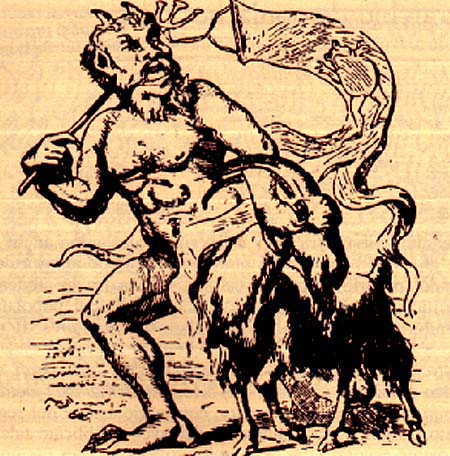
The Scapegoat Ritual in Leviticus 16

Azazel from Collin de Plancy's Dictionnaire Infernal(Paris,1825).
Leviticus 16 presents the ritual requirements for the Day of Atonement. One of the most enigmatic rituals involves the scapegoat sent off into the wilderness for “Azazel” described in Lev 16:6-10:
6 “Aaron shall offer the bull as a sin offering for himself and shall make atonement for himself and for his house. 7 Then he shall take the two goats and set them before the LORD at the entrance of the tent of meeting. 8 And Aaron shall cast lots over the two goats, one lot for the LORD and the other lot for Azazel. 9 And Aaron shall present the goat on which the lot fell for the LORD and use it as a sin offering, 10 but the goat on which the lot fell for Azazel shall be presented alive before the LORD to make atonement over it, that it may be sent away into the wilderness to Azazel.
There has been much speculation about who or what “Azazel” was: the main interpretations have been a local deity, a wilderness goat-demon, or a desert mountain. Later Jewish literature, notably the Book of Enoch, understood Azazel as a demon, one of the fallen angels and brings him into its complex mythology of supernatural angels and demons.

Rabbinic interpretation understood Azazel to be a cliff off which the goat was driven to its death.
The Rabbis, interpreting "Azazel" as "Azaz" (rugged), and "el" (strong), refer it to the rugged and rough mountain cliff from which the goat was cast down (Yoma 67b; Sifra, Ahare, ii. 2; Targ. Yer. Lev. xiv. 10, and most medieval commentators). Most modern scholars, after having for some time indorsed the old view, have accepted the opinion mysteriously hinted at by Ibn Ezra and expressly stated by Nahmanides to Lev. xvi. 8, that Azazel belongs to the class of "se'irim," goat-like demons, jinn haunting the desert, to which the Israelites were wont to offer sacrifice (Lev. xvii. 7 [A. V. "devils"] (from the Jewish Encyclopedia).
Of course, all of that may be for naught if this Hittite parallel is correct and the term is connected with a type of offering.
“In the Leviticus 16 ritual a crux has always been the term laʿazāʾzēl rendered in the Septuagint and Vulgate by “as a scapegoat” (followed by the English AV), but replaced in more recent English translations by “for Azazel,” sometimes thought to denote a wilderness demon. Appealing to scapegoat rites in the Hurrian language from the Hittite archives, Janowski and Wilhelm would derive the biblical term from a Hurrian offering term, azazḫiya. This is particularly appealing to me. There were two goats used in the Leviticus 16 ritual. One is designated for Yahweh as a “sin offering” (Heb. ḥaṭṭāʾṭ, LXX peri hamartias) (16:9), and the other is “for Azazel,” but is presented alive before Yahweh to make atonement, and is sent away into the wilderness “to/for Azazel.” The contrast is twofold: (1) Yahweh versus Azazel, and (2) sin offering versus Azazel. If one adopts the first, Azazel seems to be a divine being or demon, who must be appeased. But if one adopts the second as primary, the word ʿazāʾzēl represents the goal of the action. In the system of Hurrian offering terms to which Wilhelm’s azazḫiya belongs, the terms represent either a benefit that is sought by the offering (e.g., keldiya “for wellbeing,” cf. Heb. šelāmîm), or the central element offered (e.g., zurgiya “blood”). If Janowski and Wilhelm’s theory is correct, the Hebrew term would not denote a demon as recipient of the goat, but some benefit desired (e.g., removal of the sins and impurities) or the primary method of the offering (e.g. the banishment of the goat).”[1]
Similar rituals are widely attested in the ancient Near East with examples from Ebla and elsewhere. I'm sure much more could be said about the practice and its ancient parallels. Leviticus 16 and the term Azazel provide a fascinating example of how misunderstandings and speculation sometimes spin off into elaborate traditions that fall far from the likely original meaning of the biblical text.

Harry A. Hoffner, Jr., “Hittite-Israelite Cultural Parallels” in Hallo, W. W., & Younger, K. L. (2003). Context of Scripture, vol. 3 (xxxii). Leiden; Boston: Brill.

Friday, July 23, 2010

Professor Pardee's Promotion

Professor Dennis Pardee at the University of Chicago has been appointed to a named chair in Hebrew Studies.

Dennis Pardee has been appointed the Henry Crown Professor of Hebrew Studies.
Currently Professor in Near Eastern Languages and Civilization, Pardee studies northwest Semitic languages and is a leading scholar of Ugarit, the language spoken by the residents of the ancient Syrian city. He is the author of two–volume scholarly translation of Ugaritic rituals, many of which had been difficult for scholars to access before the publication of Pardee’s translation.
In 2008, Pardee translated the inscription on an ancient stone slab uncovered by an Oriental Institute team in southeast Turkey. The slab provided the first written evidence in the belief that the soul was separate from the body.
Pardee teaches intermediate and advanced Biblical Hebrew, and is a 2010 recipient of the University’s Graduate Teaching Award. He received a Guggenheim Fellowship in 1995. In 2007 he delivered the British Academy’s prestigious Schweich Lectures on Biblical Archaeology.
He received his Ph.D. from UChicago in 1974 and has been teaching at UChicago since 1972.
Congratulations to Prof. Pardee!

Wednesday, May 26, 2010

Opening for a Classical Hebrew Professor at UW-Madison

Below is the official job posting for the open position in Classical Hebrew and NW Semitic languages at the University of Wisconsin-Madison.
CLASSICAL HEBREW LANGUAGE AND BIBLICAL LITERATURE     (PVL #64493)
The Department of Hebrew and Semitic Studies at the University of Wisconsin-Madison invites applications for a tenure-track position at the assistant professor level, starting August, 2011. Ph.D. required.
Area of specialization:  classical Hebrew in its Northwest Semitic context. Teaching duties include advanced and graduate level courses in Hebrew and Semitic languages, epigraphy, and texts (including biblical literature), undergrad courses in Hebrew Bible (in translation), and supervision of the undergrad Biblical Hebrew program. Evidence of teaching excellence and scholarly production are crucial.  Unless confidentiality is requested in writing, information regarding the applicants must be released upon request. Finalists cannot be guaranteed confidentiality. Women and minorities are encouraged to apply. UW-Madison is an equal opportunity/affirmative action employer. A background check may be required prior to employment.
Send two hard copies of a cover letter, a CV, three letters of recommendation, official undergraduate and graduate school transcripts to: Search Committee Chair/1346 Van Hise Hall/ 1220 Linden Dr./Madison, WI  53706-1558.  Candidates may also submit a writing sample of up to 30 pages. Deadline for applications is August 15, 2010.
For inquiries, please contact brenner@wisc.edu

Friday, April 2, 2010

Written Hebrew & the Composition of the Bible

Too often our discussions of how and when the biblical books were composed fail to take into account the historical evidence for written language and text. That is, we rarely consider when the technology of writing was actually available for use composing the biblical texts. The tradition that Moses wrote the Pentateuch, for example, still has to explain how he could have written much of it in good 8th-7th century Judean Hebrew from his 13th century home in the wilderness. If Moses wrote the Pentateuch, what did he write the original in? Hebrew wasn’t an option then. Proto-Canaanite? Akkadian? Egyptian?

In recent years, a few books have come out dealing with this issue of scribal schools and scribal culture. The most well-known and influential to date have been David Carr’s Writing on the Tablet of the Heart (2005) and Karel van der Toorn’s Scribal Culture and the Making of the Hebrew Bible (2007).

sanders inv of Heb But the book that I think best deals with the question of how, why, and when the Israelites started writing Hebrew and how that impacts our theories of biblical composition is The Invention of Hebrew by Seth L. Sanders (2009). Perhaps the fact that Sanders provides theoretical and evidential support for some of what I’ve already long suspected about biblical Hebrew and the composition of the Hebrew Bible makes his argument land persuasively on me, but I will be very surprised if this book doesn’t have a major impact on future studies exploring the composition of particular biblical books. It is, in my opinion, a game-changer. Here is a representative quote:

By 700 B.C.E. local scripts like Hebrew have escaped the royal chancery; Israelites have used the old linear alphabet to create a literature. In the late Iron Age we find extended linear alphabetic texts in a spectrum of genres: letters from all walks of life, poetry, and ritual blessings. In the kingdoms of Israel and Judah the new writing had assumed a definitive status. Yet in the very territory and history Hebrew described, the literary silence from which it emerged had been forgotten.

The most successful product of this new writing, the Bible[,] reads as if written Hebrew had always existed, preserving no memory of its origins or what came before it. From the beginning, God had written the language that He, and Israel, spoke: Hebrew. Memory has been a major theme of recent Bible scholarship that tries to reconcile Near Eastern history with biblical literature. But the Bible was also a powerful tool for forgetting: the gap in memory between Late Bronze Age and late Iron Age culture erases a decisive moment in the history of writing in Israel, the point at which written Hebrew was invented. (p. 80)

Disclosure of Material Connection:  I have a material connection because I received a review copy (book, CD, software, etc.), or an item of nominal value that I can keep for consideration in preparing to write this content. This is not a full book review, but to be safe, I wanted to acknowledge the connection. Thanks to University of Illinois Press for sending along a copy of this book.

Sunday, March 28, 2010

Inscription of the Day: Yehimilk

The Yehimilk inscription dating to the mid-tenth century B.C.E. was discovered in 1929. It consists of seven lines of text inscribed over the top of a previous pseudo-hieroglypic inscription that was written within registers dividing the lines (Gibson 1982, 17). The language of the inscription is Old Byblian, an early Phoenician dialect used primarily in the city of Byblos.
Yehimilk_DTM line drawing
The text is a royal dedicatory inscription by a king of Byblos. Several similar inscriptions also dating to the tenth century B.C.E. have been found at Byblos – Abibaal, Elibaal, and Shiptibaal. The basic pattern throughout these inscriptions is:
The object which PN king of Byblos, son of PN, king of Byblos built/brought for DN. May DN prolong the days of PN and his years over Byblos. (PN = proper name; DN = deity name)
This pattern was not limited to the inscriptions from Byblos but should be seen as a common formula for dedicatory inscriptions in the Canaanite dialects. The formula has even been found in a seventh century BCE inscription from Ekron, a prominent Philistine city (Gitin 1997).
Yehimilk transcription


Translation:

1 (This is the) temple which Yehimilk king of Byblos rebuilt. 2 He restored all the ruins of 3 these temples. May Ba’al-shamem and Ba’alat 4 of Byblos and the assembly of the 5 holy gods of Byblos prolong the days of Yehimilk and his years 6 over Byblos. For [he is] a legitimate king and a 7 good king  before the h[oly] gods of Byblos.
The fact that Yehimilk doesn’t give us his lineage (i.e., I am Yehimilk, son of Abibaal, son of . . . ) but stresses that he is a good and legitimate king of Byblos suggests that he is a usurper (like Zakkur in an Aramaic inscription that we’ll get to later).

References:
Gibson, John C. L. 1982. Textbook of Syrian Semitic inscriptions: Volume III: Phoenician Inscriptions. Oxford: Clarendon Press.
Gitin, Seymour, Trude Dothan, and Joseph Naveh. 1997. A royal dedicatory inscription from Ekron. Israel Exploration Journal 47, : 1-16.

Friday, March 26, 2010

Pondering the Qeiyafa Ostracon

After refreshing my amateur paleography skills by revisiting the Gezer Calendar and the Siloam Tunnel inscriptions, I thought I'd have another look at the Khirbet Qeiyafa ostracon.

So I looked and attempted to transcribe what I could see from both Misgav's and Yardeni's line drawings and the photos from the Hebrew University. Even so, I was still unable to make heads or tails of Qeiyafa. My transcription has many blanks where I was uncertain of the letter and couldn't even hazard a guess.

I set the Qeiyafa ostracon aside again and went looking for information on 'Izbet Sartah, recalling that I was told it would make a better paleographical comparison than Gezer, for example.

The 'Izbet Sartah inscription 
(drawing via www.andreascenter.org)

The Qeiyafa discovery is important because of its 10th century dating. But the script appears much less developed than a 10th century inscription like Gezer. The better paleographical analogue is a 12th century text - 'Izbet Sartah. All of that is introduction to this one idle musing. What if the 10th century archaeological context for the ostracon merely provides a terminus ad quem for a possibly earlier text? If Qeiyafa is more like 'Izbet Sartah than Gezer (left to right writing, more primitive letter forms, etc.), then isn't it more likely that Qeiyafa is a 12th or 11th century text? And if that's the case, is it really even a possibility that we could call the language of the text Hebrew? Any thoughts from those of you more learned in paleography than I? 

Saturday, March 20, 2010

Inscription of the Day: Siloam Tunnel

Very rarely does archeological evidence connect closely with the biblical account. This inscription (if one accepts the dating) may be one of those times.

The Siloam Tunnel inscription dates to around 700 BCE during the reign of Hezekiah. The date is based on paleographical analysis of the inscription which shows features typical of 8th century BCE Hebrew.[1] The inscription seems to commemorate the completion of the Siloam Tunnel connecting the Gihon spring to the pool of Siloam inside Jerusalem, a public work attributed to King Hezekiah in 2 Chronicles 32:30 and necessitated by the Assyrians’ impending siege.
2 Chr 32:30 This same Hezekiah closed the upper outlet of the waters of Gihon and directed them down to the west side of the city of David. And Hezekiah prospered in all his works.
The language is very similar to biblical Hebrew, and the spelling (orthography) fits the late 8th century with final but not internal matres (vowel letters). It was found on the wall of the tunnel in 1880.


Transcription
[הנקבה וזה היה דבר הנקבה בעוד [ההצבם מניפם את
הגרזן אש אל רעו ובעוד שלש אמות להנקבה נשמע קל אש ק
רא אל רעו כי היתה זדה בצר מימני . . . ובים ה
נקבה הכו החצבם אש לקרת רעו גרזן על גרזן וילכו
המים מן המוצא אל הברכה במאתים ואלף אמה ומא
ת אמה היה גבה הצר על ראש החצבם
Translation
(1) The breach.  And this was the record of the breach.  While [the workmen were swinging,] (2) the pick-axe, each man toward his companion, and while there were three cubits to be tunneled, a voice was heard- each man called (3) to his companion because there was a crack in the rock from the right…and on the day of (4) the breach the workers struck, each man to meet his companion, pick-axe against pick-axe.  And the waters flowed (5) from the source to the pool: one thousand and two hundred cubit[s].  And one hundred (6) cubit[s] was the height of the rock over the head of the workmen.
Reference: The line drawing above is from J. Renz and W. Rollig, Handbuch der altehebraischen Epigraphik, Wissenschaftliche Buchgesellschaft, 1995.

1 This dating was famously (and foolishly) challenged by J. Rogerson and P. R. Davies (“Was the Siloam Tunnel Built by Hezekiah?” Biblical Archaeologist 59:3 (1993), 138-149) who argued the inscription was Hasmonean. An international dream team of paleographers and philologists (including Jo Ann Hackett, Frank Moore Cross, P. Kyle McCarter, Jr., Ada Yardeni, André Lemaire, Esther Eshel, and Avi Hurvitz) administered a massive smackdown in the pages of BAR a few years later (“Defusing Pseudo-Scholarship: The Siloam Inscription Ain't Hasmonean.” BAR (Mar/Apr 1997), 41-68).

Tuesday, March 16, 2010

Comments on the Gezer Calendar Script

In my previous post on the Gezer Calendar inscription, I didn’t go into too much detail about the script in which it was written. That’s because I’m not really trained as a paleographer. I’m a biblical studies person who dabbles in Northwest Semitic inscriptions. I enjoy epigraphy and paleography, but I’ve never had a chance to study with a specialist in Semitic inscriptions and scripts.

In comments on the previous post, I was asked whether the Gezer Calendar shows any evidence of being a distinctly Hebrew script (i.e., not Phoenician). Here I offer my non-specialist evaluation of the script. I rely heavily on Yardeni and Cross for my quasi-expertise.

Yardeni (1997, 15) identifies the script as Phoenician. Gibson (1971, 1) calls it the “Old Hebrew script” but goes on to point out close parallels with characters from Old Byblian texts (i.e. Phoenician). Since the Phoenician script served as an international script until the 8th century BCE (Yardeni 1997, 15), a Hebrew inscription in Phoenician script would not be unusual.

There is some debate over whether the language of the text is Hebrew or Phoenician. The dividing line between the two languages is not very distinct at this stage. An important feature identifying the language of the inscription as Hebrew is the reconstruction of {h} in the name in the margin, making a Yahwistic theophoric element. One isogloss indicating a northern Hebrew dialect is the diphthong reduction with קץ .Cross believes Gezer shows initial tendencies marking the emergent Hebrew script (1980, 14).

The identification of the script as Phoenician is an indicator of the age of the inscription, placing it earlier than the Hebrew texts of the mid to late 9th century BCE. According to Yardeni (1997, 17), Hebrew inscriptions from the later time period show tendencies distinct from the Phoenician script such as a cursive leftward curve to the long downstrokes. In the Gezer script, the downstrokes on the “long-legged” letters tend to be straight. However, the Gezer script also has other features which Yardeni identifies as Hebrew tendencies including the waw with a concave top (though inconsistent in this text) and the x-shaped taw (ibid.). The elongated vertical strokes of ‘aleph, waw, kaph, mem, and resh are also rudimentary features of Hebrew script (Cross 1980, 14). The abcedary found at Tell Zayit exhibits similar archaic features and has also been identified as Hebrew and dated to the mid-10th century.

The paleographical evidence for dating the Gezer Calendar to the 10th century is strong. The ‘aleph, waw, and zayin are more advanced than 11th century, but the script lacks the cursive tendency indicative of Hebrew scripts of the 9th century and later (Cross 1980, 14, 18 n. 16).

It may be best to identify the Gezer script as transitional Hebrew between the standard Phoenician from the 10th century and the earliest Hebrew from a century later since it shows features of both scripts.

References

Cross, Frank Moore. 1980. “Newly Found Inscriptions in Old Canaanite and Early Phoenician Scripts.” BASOR 238: 1-20.

Gibson, John C. L. 1971. Textbook of Syrian Semitic Inscriptions. Vol. 1: Hebrew and Moabite Inscriptions. Oxford: Clarendon.

Yardeni, Ada. 1997. The Book of Hebrew Script. Jerusalem: Carta.

Saturday, March 13, 2010

Inscription of the Day: The Gezer Calendar

The Gezer Calendar is a Hebrew inscription on limestone found at excavations at Gezer in 1908 by R.A.S. Macalister. (Technically, a visitor to his excavation found it sitting atop his trash heap. Macalister was not that great of an archaeologist.) It is one of the earliest Hebrew inscriptions, dating to the late 10th century BCE (ca. 925 BCE). I made the line drawing below in 2007 for a class on Hebrew/Canaanite inscriptions.

  ירחו אסף
ירחו זרע
ירחו לקש
ירחו עצד פשת
ירחו קצר שערם
ירח קצר וכל
ירחו זמר
ירח קץ
אביה


Its (two) months of harvest.
Its (two) months of sowing.
Its (two) months of late growth.
Its month of cutting flax
Its month of barley harvest.
Its month of harvest and measuring.
Its (two) months of pruning.
Its month of summer (fruit).
'Abiyah

Issues
What kind of a text is this? An agricultural calendar? A school text? Is it poetry? I like to think of it as poetry because of the assonance and terse lines, but it's one odd poem if that's the case. There are two main issues with this inscription besides figuring out what it actually means.

First, the waw on ירחו is unusual. It likely reflects a 3ms suffix on a dual noun (Albright 1943). It can't be singular because the waw has to be consonantal at this stage of Hebrew. Other explanations have been offered such as waw as a case ending (Tropper 1993). Vocalization is uncertain. In Tiberian, I would vocalize it as יַרְחָיו.

The other primary uncertainty with this inscription is the phrase עצד פשת. Most likely it says “cutting flax” but עצד is a rare root in Hebrew. The main problem is that if the activities are in sequence, then the flax harvest would be out of place. Attempts to find another meaning for פשת, however, have been less than convincing (Dobbs-Allsopp 2005, 161).

This is an important inscription for the development of Hebrew as a written language. Oh, and one more thing, the last line is usually read as a personal name, perhaps the scribe or poet or whatever (in case you were wondering).

References & Resources
Albright, W. F. 1943. “The Gezer Calendar.” BASOR 92: 16-26.
Ahituv, Shmuel. 2008. Echoes from the Past: Hebrew and Cognate Inscriptions from the Biblical Period. Carta.
Cross, Frank Moore, Jr. and David Noel Freedman. 1952. Early Hebrew Orthography: A Study of the Epigraphic Evidence. New Haven: American Oriental Society.
Cross, Frank Moore. 1980. “Newly Found Inscriptions in Old Canaanite and Early Phoenician Scripts.” BASOR 238: 1-20.
Dobbs-Allsopp, F. W., et. al. 2005. Hebrew Inscriptions: Texts from the Biblical Period of the Monarchy with Concordance. Yale University Press.
Gibson, John C. L. 1971. Textbook of Syrian Semitic Inscriptions. Vol. 1: Hebrew and Moabite Inscriptions. Oxford: Clarendon.
Lidzbarski, Mark, et. al. 1909. “An Old Hebrew Calendar-Inscription from Gezer.” PEFQ.
Tropper, Josef. 1993. “Nominativ Dual *yarihau im Gezer-Kalendar.” ZAH 6/2: 228-231.
Yardeni, Ada. 1997. The Book of Hebrew Script. Jerusalem: Carta.

Monday, January 25, 2010

Hebrew University Responds to Khirbet Qeiyafa Buzz

Now it's always nice to have lots of media attention aimed at archaeological excavations because it raises public awareness of the kind of research that's being done. However, there's a tendency with finds related to the biblical world to get carried away in interpreting those finds to "prove" the Bible is true, historical, etc. This is evident most recently in Gershon Galil's very gratuitous and sensationalized reading of the ostracon from Khirbet Qeiyafa. I was browsing the official excavation website today, and I found that they've published an open letter to Galil regarding his findings and the methods he used in reporting them. Apparently, he was taking credit for readings and conclusions that weren't originally his. Tsk tsk. On top of that, his reconstructions were entirely speculative. Already knew that.

Here is the letter, reproduced in full from the "Khirbet Qeiyafa Ostracon Project" website of the Hebrew University of Jerusalem.

Open Letter to Prof. Gers[h]on Galil, Haifa University
The Khirbet Qeiyafa expedition would like to draw your attention to a number of problematic statements that appeared in the Haifa University press release, dated January 10, 2010 (http://newmedia-eng.haifa.ac.il/?p=2043). These statements raise several problems of ethics and scholarship, which unfortunately have created a serious public misunderstanding concerning the Qeiyafa ostracon.
Ethics
  1. While the expedition is run by two directors, only one (Yosef Garfinkel) is mentioned. This is surprising, as last year co-director Saar Ganor spent some time on guiding a tour of Khirbet Qeiyafa for you and other members of the Department of Biblical Studies of Haifa University.
  2. The letters that appear on the ostracon were deciphered by the epigraphist Dr. Haggai Misgav, who has published his reading in Hebrew and English. In the press release, however, you are presented as the person who deciphered the inscription, taking full credit for the entire reading. Again, this is surprising, as last year Haggai Misgav gave a presentation on the inscription at the Department of Biblical Studies of Haifa University.
  3. In a few cases you give alternative readings of the inscription that were published by Dr. Ada Yardeni. These, again, are presented as your original reading.
  4. From the very first reading of the inscription, the words אל תעש were understood by Haggai Misgav as an indication that the language of the inscription is Hebrew. In the press release this understanding is presented as your original contribution.
  5. Prof. Shmuel Ahituv suggested in his publication that עבד (worship) is another indication for Hebrew. In the press release, however, this is presented as your own contribution.
  6. When you examined the ostracon, you requested permission to take a few photographs for your personal use only. One of these photographs appears in the press release.
    Scholarship
Your contribution consists not of reading or deciphering the inscription, but rather of speculative reconstruction of "missing" letters and words. Most of the third line and the center of the fifth line of the ostracon are illegible and the letters you suggest are entirely speculative. The main words that support your thesis (אלמנה, יתום, אביון) are reconstructed and do not appear as such in the legible parts of the ostracon.
On the basis of your own reconstruction, you draw conclusions, among others, about when the Bible was written. Does this sound like a scientific methodology?

Wednesday, January 13, 2010

Khirbet Qeiyafa: The Discussion Continues

John has provided us with the lowdown on the inscription today, mediating between the extreme caution of Rollston and the sensational overblown conclusions of the media. I agree with John's assessment and suggest you click through to his post.

He also links to the recent discussion of Khirbet Qeiyafa with Seth Sanders (author of The Invention of Hebrew) on The Book & The Spade. I haven't yet had a chance to listen, but I'm looking forward to it.

Tuesday, January 12, 2010

More on Khirbet Qeiyafa

The seething cauldron of opinions on the Khirbet Qeiyafa inscription has slowed from a roiling boil to a light trickle, but I keep stumbling across additional reactions around the blogosphere. Today John Hobbins has pointed us to a post by Neil Silberman from several days ago offering his take on the inscription and all the ensuing hoopla. This was my favorite part (emphasis added).
Professor Gershon Galil of the University of Haifa suggests that the “contents of the text express social sensitivity to the fragile position of weaker members of society. The inscription testifies to the presence of strangers within the Israeli society as far back as this ancient period, and calls to provide support for these strangers. It appeals to care for the widows and orphans and that the king – who at that time had the responsibility of curbing social inequality – be involved. This inscription is similar in its content to biblical scriptures (Isaiah 1:17, Psalms 72:3, Exodus 23:3, and others), but it is clear that it is not copied from any biblical text.”    
These are all notable sentiments, no doubt, but their identification on an ancient pottery sherd is all a fantasy of wishful thinking that will thrill the faithful yet demonstrate little more than Galil’s clever crossword puzzle skill.
Silberman's right. The text is difficult and the reconstruction is tenuous. I hate gratuitous reconstructions of fragmentary inscriptions! It seems so disingenuous as a scholar to massage your evidence to support your conclusions. I'm not just thinking of Galil here.

In other news, the official website for the Qeiyafa ostracon has been updated with many additional photos and line drawings of the inscription including the following (via Agade):
1. Colored photo of the ostracon by Clara Amit, Israel Antiquities Authority. 2. Infrared photo of the ostracon by Clara Amit, Israel Antiquities Authority. 3. Drawing of the ostracon by Haggai Misgav. 4. Drawing of the ostracon by Ada Yardeni. 5. The upper left corner of the ostracon by CRI laboratory. 6. The ostracon in full flattened contrast by Megavision laboratory. 7. The heavily reconstructed interpretation of Gershon Galil with his drawing.
Update: Seconds after first publishing this post, I received an email on the Agade mailing list with another, most authoritative blog reaction from Christopher Rollston. He provides a summary of what we know and explains where the sensational conclusions are going well beyond the evidence.

Friday, January 8, 2010

Quick Primer on Khirbet Qeiyafa


It's been brought to my attention that a little background might be helpful for my last two posts, so here is a brief rundown on the Khirbet Qeiyafa discoveries and their importance for those of you who don't have time to read all the online discussion that's hit in the last 24 hours.


The key discoveries: The excavation is led by Yosef Garkinkel. I heard him speak at SBL last November. Their results demonstrate that this was a fortified city on the border between Philistia and Judah from the mid-11th century to the mid-10th century BCE. This conclusion creates serious problems for Israel Finkelstein's assertions that there were no fortified cities in Judah before the 9th century BCE. They found evidence at Khirbet Qeiyafa of urban planning of a particularly Judean-style found also at 4 other sites in Judah including Beersheba, Tell en Nasbeh, and Tell Beit Mirsim. The inscription they found has gotten most of the attention, however. The inscription is probably Hebrew found in an 10th century BCE context. Unfortunately, many of the conclusions being claimed for the significance of the inscription would be more effective if placed in the context of the interpretation of the site as a whole.


The significance of the inscription: We're not sure if other inscriptions from this time are technically "Hebrew" or not, so if this is, that's big. The written dialects in the area looked similar and there aren't too many clues to distinguish them. This inscription probably has a few. That pushes us back 100 years or so in our knowledge of ancient Hebrew's development.


The reported over-sensationalized significance: The inscription proves there was a united monarchy and proves some of the Bible was written much earlier than some scholars think. Take with a grain of salt.


The reality about the United Monarchy: The entire site where this was found suggests there was a central government and this was a border fortress. It blows away theories that Judah at this time was a regional backwater with little civilization. The inscription mentions a "king" depending on how one reads it. It doesn't prove the United Monarchy as described in the Bible existed. It creates a plausible context for something similar being possible.


The reality about the writing of the Bible: The inscription shows that writing in Hebrew was happening during the 10th century BCE. It doesn't prove anything about when parts of the Bible were written. It has long been commonly thought that some of the earliest layers of the Pentateuch may have been written during this century anyway (though this has been challenged in recent years). This simply shows that texts were being written during this time; therefore, the sources behind the Bible could have been written during this time. One thing that confuses me though -- if Hebrew didn't really exist before the 10th-9th centuries BCE, then how did Moses in the 14th-13th centuries BCE know it when he wrote the Pentateuch?

Roundup of the Qeiyafa Ostracon Buzz

The story of the oldest Hebrew inscription ever has hit the usual news sources and lit up the biblioblogosphere. This post has all the links I've found up through 2 minutes ago.

Some of the news stories have a small photo of the Khirbet Qeiyafa ostracon. A few of the letters are barely legible. The photo obviously wasn't taken with the intention of providing a readable copy.


Photo courtesy of the University of Haifa

HT for the article with photo: Evangelical Textual Criticism

The ostracon elsewhere in the news and the biblioblogosphere:

Ha'aretz: Fair and balanced as always-"Deciphered etching sheds new light on Bible's origin"

Jerusalem Post: The award for best misleading headline--"Inscription indicates Kingdom of Israel existed in the 10th century BCE"

James McGrath: A NT guy wading into epigraphy in ancient Israel - but still with helpful cautions about linguistic dating of texts (which is a misguided effort in my opinion when applied to the biblical text).

Jim Getz: Why the fuss over one small stray inscription?

Jim Davila: "the more banal reading is to be preferred."

Menachem Mendel: "Never a dull moment for the history of the Hebrew language."

John Hobbins: I posted a completely different reading back in October.

Claude Mariottini: Bottom line - writing is occurring outside of Jerusalem earlier than thought.

Dr. Platypus: Something like a United Monarchy (found via link to Claude Mariottini)

Tony Cartledge: Interpretation is a Long Stretch (via Dr Platypus link)

Henry Neufeld: "Writing a small text on an ostracon and writing the final, redacted Pentateuch are substantially different things."

Joel Watts: Highlighting the press release and hounded by Hobbins. John, all he said was that it was interesting. No need to remind all of us that this has been in and out of the news for the last 18 months. (That said, I agree with John's evaluation of the importance of the find and mention him only to draw attention to his comments at these various posts which are quite helpful.)

Duane Smith: Abnormally interesting conclusion - "I do worry that some, myself included, are asking this inscription and the very few others from the same period to carry more linguistic, historical, theological and even political weight than they can bear."

If all of that doesn't keep you busy, there's more at the official site for the excavation (link via Jim Getz).

Thursday, January 7, 2010

Ancient Hebrew Inscription from Khirbet Qeiyafa

I've been waiting since October 2008 to get more details on the ostracon discovered at Khirbet Qeiyafa. Today there was finally an official press release with a translation and a line drawing of the inscription. Reading a line drawing is so much easier. See all of the outlined letters? Those are the ones the epigrapher couldn't really make out, so they made an educated guess. It's probably fairly accurate. Certain strokes are indicative of which letter is which even if it's only partially visible.
University of Haifa Press Release
19412_web
Caption: A breakthrough in the research of the Hebrew scriptures has shed new light on the period in which the Bible was written. Professor Gershon Galil of the Department of Biblical Studies at the University of Haifa has deciphered this inscription on a pottery shard discovered in the Elah valley dating from the 10th century BCE (the period of King David's reign), and has shown that this is a Hebrew inscription. The discovery makes this the earliest known Hebrew writing. The significance of this breakthrough relates to the fact that at least some of the biblical scriptures were composed hundreds of years before the dates presented today in research and that the Kingdom of Israel already existed at that time.
Credit: Courtesy of the University of Haifa
Some of this may echo what Bob Cargill has already said, but I think it's worth pointing out some of the over-reaching assumptions and conclusions that are being drawn by Prof. Galil as quoted in the press release.
Prof. Gershon Galil of the University of Haifa who deciphered the inscription: "It indicates that the Kingdom of Israel already existed in the 10th century BCE and that at least some of the biblical texts were written hundreds of years before the dates presented in current research."
A breakthrough in the research of the Hebrew scriptures has shed new light on the period in which the Bible was written. Prof. Gershon Galil of the Department of Biblical Studies at the University of Haifa has deciphered an inscription dating from the 10th century BCE (the period of King David's reign), and has shown that this is a Hebrew inscription. The discovery makes this the earliest known Hebrew writing. The significance of this breakthrough relates to the fact that at least some of the biblical scriptures were composed hundreds of years before the dates presented today in research and that the Kingdom of Israel already existed at that time.
Yes, this is probably the earliest example of the Hebrew language, but how does it follow as proof that parts of the Bible were composed hundreds of years earlier? It doesn't. It provides a plausible context for literary activity and ability, but it doesn't provide proof that scribes were creating complex literary texts like what is found in the Bible.
As for the language being Hebrew, their proof is solid, if it accurately reflects the inscription.
Prof. Galil's deciphering of the ancient writing testifies to its being Hebrew, based on the use of verbs particular to the Hebrew language, and content specific to Hebrew culture and not adopted by any other cultures in the region. "This text is a social statement, relating to slaves, widows and orphans. It uses verbs that were characteristic of Hebrew, such as asah ("did") and avad ("worked"), which were rarely used in other regional languages. Particular words that appear in the text, such as almanah ("widow") are specific to Hebrew and are written differently in other local languages.
The verb "asah" would be a good isogloss (feature distinguishing between languages or dialects), but I've struggled for some time tonight to find these specific lexical items in the line drawing of the inscription. I admit that my paleography skills are rudimentary and rusty, but I wish they'd have provided a transcription, not just a translation and drawing. Many of the letters are atypical compared to other samples of paleo-Hebrew including the Gezer Calendar. Letter orientation seems to be completely optional with aleph pointing multiple ways and dalet (if it is a dalet) attested in 180 degree different positions.
I will press on in my attempt to decipher the line drawing for myself. It may be time to break out Yardeni's Book of Hebrew Scripts. In the meantime, here is the English translation of the inscription.
English translaton of the deciphered text:
1' you shall not do [it], but worship the [Lord].
2' Judge the sla[ve] and the wid[ow] / Judge the orph[an]
3' [and] the stranger. [Pl]ead for the infant / plead for the po[or and]
4' the widow. Rehabilitate [the poor] at the hands of the king.
5' Protect the po[or and] the slave / [supp]ort the stranger.
HT: Bob Cargill