Showing posts with label Ancient Israel. Show all posts

Tuesday, May 8, 2012

The Latest from Khirbet Qeiyafa


Something really really big that has finally and totally proven the historical reliability of the Bible has once more been found. But first, some perspective:
The idea that a single, spectacular finding can reverse the course of modern research and save the literal reading of the biblical text regarding the history of ancient Israel from critical scholarship is an old one. Khirbet Qeiyafa is the latest case in this genre of craving a cataclysmic defeat of critical modern scholarship by a miraculous archaeological discovery.[1]
Khirbet Qeiyafa has proven to be a very newsworthy archaeological dig. First, there was the pretty cool ostracon announced in 2008. Then there was the sensational, unofficial, buzz-generating interpretation of that ostracon announced by Prof Gershon Galil. Professional epigraphers and archaeologists are still debating the reading and significance of the inscription (see the May/Jun 2012 issue of Biblical Archaeology Review). 

I admit that I haven't really been following the excavation since early 2010 (background from early 2010 here), but this morning Yosef Garfinkel, the lead archaeologist from Hebrew University excavating at Khirbet Qeiyafa, has announced the discovery of artifacts interpreted as proof of King David's ancient Israelite kingdom in the 10th century BCE. The announcement was highly anticipated but the news conference (as with many such announcements) has the ring of an attempt to head off the battle over interpretation of the finds before it's even begun. Once again, I find myself stuck between wanting to cheer on the maximalist interpretation and recognizing the valid questions raised by those of a more minimalist leaning.  

Image: The Hebrew University of Jerusalem
In short, clay and stone boxes were discovered in connection with three large rooms interpreted as having cultic (religious) significance. The site is interpreted as Israelite based on the absence of pig bones and the absence of graven images. The boxes and related artifacts are being interpreted as scale model versions of the "Ark of God." 

However the artifacts are interpreted, it is a significant find which highlights the continuing importance of this site for reconstructing the history of the region in the 10th century BCE. In addition to reading the major press release version of the story, I recommend balancing your understanding with George Athas' observations on the discovery. I imagine the rest of the biblioblogosphere is exploding with the story even as we speak...let's take a look...here's a post on the subject by Todd Bolen; Jim Davila; Brian LePort; Jim West; Duane Smith. Of course, I'm really waiting for a response from biblioblogger archaeologist-in-chief, Bob Cargill.

[1] Israel Finkelstein and Alexander Fantalkin, “Khirbet Qeiyafa: An Unsensational Archaeological and Historical Interpretation” Tel Aviv 39.1 (2012), 58. From G.M. Grena’s quote in a comment onAren Maier’s blog

Thursday, October 20, 2011

The Historical Jeremiah

Many readers of the Bible come to the text with the unexamined (and usually unqualified) assumption that the literature is unequivocally historical. In other words, the people existed and the events happened more or less as described by the text. But was the version of the character presented in the text an accurate portrayal of the real, historical figure? We can't know. I've realized that history-writing is much more about creating a plausible narrative about the past than about precisely recording the details. So, the historical person and the biblical/literary character are not one and the same. In the case of Jeremiah, no scholar highlighted the difficulty of reconstructing historical and biographical information from the biblical account as thoroughly as the late Robert P. Carroll. Despite his reputation as the quintessential skeptic and practitioner of a hermeneutic of suspicion in biblical exegesis, I found his honesty about the limits of our knowledge refreshing and his conclusions quite in line with what I've proposed before.
The ‘I’ and ‘me’ of various prose pieces are assumed by most exegetes to represent Jeremiah as speaker, and the editorial framework frequently attributes prose actions and statements to him. Reading the book at face value and following the dictates of traditional and conventional readings of the text, the bulk of modem scholars have understood Jeremiah to be the book of the life and times of Jeremiah the prophet, with direct access to his words, deeds, innermost thoughts and reflections. Such an approach presupposes so much historical information to which nobody has access and a one-to-one correspondence between text and social reality that it is an extremely problematical reading of the book. The precise relation between the character constructed by the writers of the tradition and a hypothesized ‘historical’ Jeremiah behind the book is a very difficult question to answer, though not acknowledging its existence in the first place does not make it any the less real a problem for interpreting the book. For the purpose of this chapter the character of Jeremiah presented in the book will be treated as the creative fiction of the editors and writers who produced it and the relation between the ‘historical’ Jeremiah and the ‘fictional’ Jeremiah will be left to the speculative sophistications of the reader....

Although the majority of scholars continue to read Jeremiah as a biographical or autobiographical set of documents, and this ‘compact majority’ must be recognized for whatever value may be attached to such statistical reports, we cannot prejudge the issue as if there were no alternative or more feasible accounts of how the book was put together. Such accounts undergird the logic of the claim that perhaps the figure of Jeremiah is more the creation of the tradition than the creator of it.**
The bottom line is that reading any biblical book as if it provides direct historical/biographical information is problematic, especially in light of the clear theological program that motivated the anonymous writers behind the bulk of the historical narrative (the so-called Deuteronomists and the Deuteronomic school). What was their theological program and how did it affect the "spin" they put on the biblical history? Tune in next week...
**Quoted from R.P. Carroll, Jeremiah (London; New York: T&T Clark, 2004), 75, 77.

Friday, July 1, 2011

Computer Cracks Code of Source Criticism

If you haven't already heard, a fascinating study by an Israeli research team (comprised of 2 computer scientists and a Bible scholar) suggests that the fine bits of circumstantial data used by Bible scholars to tease out the varying voices of biblical sources and authors can be run through a computer model as a way of separating the different strands of composition. The Pentateuch and the book of Isaiah are the most debated (probably) so the results on those sections will give us the most to talk about. Here are some quotes from the article at Ha'aretz.
The new software analyzes style and word choices to distinguish parts of a single text written by different authors, and when applied to the Bible its algorithm teased out distinct writerly voices in the holy book.
...
When the new software was run on the Pentateuch, it found the same division, separating the "priestly" and "non-priestly." It matched up with the traditional academic division at a rate of 90 percent - effectively recreating years of work by multiple scholars in minutes, said Moshe Koppel of Bar Ilan University near Tel Aviv, the computer science professor who headed the research team.
...
Similarly, the book of Isaiah is largely thought to have been written by two distinct authors, with the second author taking over after Chapter 39. The software's results agreed that the book might have two authors, but suggested the second author's section actually began six chapters earlier, in Chapter 33.
This is very interesting for my continued musings on the composition of the book of Isaiah. I'd always felt the "voice" in Isaiah had started to switch to "Deutero-Isaiah" (traditionally the writer of 40-55) a bit before the historical interlude in chapters 36-39 was (more or less) cut-and-pasted from 2 Kings 18-20, probably in chapters 34-35. I hadn't thought of chapter 33 as Deutero-Isaiah, though. Food for thought.

A copy of the paper from the conference where this research was presented can be accessed here.

HT: Agade

Thursday, February 17, 2011

Continuity Errors in the Hebrew Bible?

One of the features of narrative in the Hebrew Bible that as long caught my notice is the common use of place names prior to the aetiological story that explains the source and significance of the name. Logically this inconsistency can only mean that either a later editor went back through and updated names without regard for continuity OR a later writer was using names he was familiar with before getting to the story that explained where the name came from. Either way, the biblical writers were less concerned with what today might be called continuity errors. The most concise example of the phenomenon is Genesis 33:17.

Genesis 33:17 (ESV):

17 But Jacob journeyed to Succoth, and built himself a house and made booths for his livestock. Therefore the name of the place is called Succoth.  [Succoth = booths]

A more chronologically problematic example is the use of the name "Bethel" in reference to Abram's travels in Genesis 12:8 and 13:3. The name "Bethel" is given by Jacob, Abram's grandson, in Genesis 28:19!

Sometimes it's unclear whether the issue is continuity or chronological disorder. For example, Judges 13:25 described Samson growing up "in Mahaneh-dan, between Zorah and Eshtaol." Samson is the last great judge portrayed in the book of Judges: the long narrative of his exploits extends from Jdgs 13 to 16. The rest of the book contains a series of bizarre yet related tales in Jdgs 17-21. Those stories contain this relevant bit of information for the name "Mahaneh-dan" (literally "camp of Dan").

Judges 18:11–12 (ESV)

11 So 600 men of the tribe of Dan, armed with weapons of war, set out from Zorah and Eshtaol, 12 and went up and encamped at Kiriath-jearim in Judah. On this account that place is called Mahaneh-dan to this day; behold, it is west of Kiriath-jearim.

Do the events of Judges 17-21 chronologically precede the story of Samson? It makes sense to group the narratives of major judges together and leave off a story that fits this time period yet focuses on no particular judge or leader.

I don't have the answers and these little details are of no great doctrinal import, but I hope this at least provides a sampling of "Things that make Bible scholars go, Hmmm...."

Thursday, January 20, 2011

2011 Archaeology Scholarships from BAR and ASOR!

I'm a little behind on announcements and other blog updates, but here are some notices I received about scholarships or volunteer opportunities if you're interested in participating in an archaeological dig in the summer of 2011. The Biblical Archaeological Society scholarship deadline is April 1st and the ASOR deadline is February 15th. Participating in a dig and getting that firsthand archaeological experience is something I've always wanted to do. I encourage those like-minded Bible scholars/armchair biblical archaeologists like myself to check out these opportunities.

Biblical Archaeological Society
WASHINGTON D.C. (January 3, 2011)—Dig Opportunities and Scholarships Available for Volunteers
The Biblical Archaeology Society is pleased to announce the publication of the Biblical Archaeology Review (BAR) Dig Issue (January/February 2011), which features a listing of excavation projects that are looking for volunteers for the upcoming 2011 season. Although an archaeological dig may not have all the glitz and glamour of a TV police drama, the clues you’ll gather and the evidence you’ll examine will have a real-life impact on our understanding of ancient cultures. In “DSI: Dig Site Investigation,”BAR’s annual guide to excavations will help volunteers find the dig that’s right for them. Extensive information on these volunteer opportunities and more can also be found online at www.digs.bib-arch.org. For more than two decades, BAR has been connecting people with the experience of a lifetime on an archaeological dig, and the upcoming season promises to be an exciting one, with opportunities available in both Israel and Jordan.
Students and applicants of all ages and levels of experience are welcome to apply to participate in an excavation this summer (minimum age requirements vary). Some programs offer course credit for participation. Applicants are encouraged to visit BAS online to explore the “Find a Dig” section of our Web site at www.bib-arch.org/digs. Whether you’re interested in the worlds of Kings David and Solomon or want to walk in the footsteps of Jesus and the apostles, we’ve got an archaeological dig for you. For each dig, we provide an in-depth description including location, historical and Biblical significance, and what the goals are for the season. You can also learn all about the dig directors and professors who will lead your summer adventure. Check out our comprehensive online guide for more about the exciting dig opportunities coming up this summer.
The Biblical Archaeology Society is proud of its ongoing Scholarship Program, which offers funding for selected applicants who wish to participate in an archaeological excavation. Quotes from some of the 2010 scholarship winners can be found in the current January/February 2011 issue of BAR, recounting what it is like to discover history firsthand. More information about our Scholarship Program, including application instructions for 2011, can be found at www.digs.bib-arch.org/scholarships.
American Schools of Oriental Research (ASOR)
ASOR offers excavation scholarships for 2011
ASOR is pleased to announce that it will once again offer scholarships for individuals to participate in excavations during the 2011 summer field season. ASOR anticipates awarding approximately 30 scholarships through its Heritage and Platt Fellowship programs. Fellowships will typically be for $1,000 each. Applications are due by February 15, 2011.
In order to apply, individuals must be student, retired, or professional members of ASOR or students enrolled at an ASOR-member school. Applicants are encouraged to apply for both Heritage and Platt Fellowships. While two applications must be submitted, applicants may use the same information on both applications. Details on the fellowship programs can be found at the following URLs:

Thursday, December 2, 2010

Full-Size Replica of Noah's Ark Planned!!

Exciting news from Cincinnati! If you haven't yet had the chance to visit the Creation Museum, you will soon have no excuse because you simply will not be able to resist the lure of seeing a replica of Noah's Ark at full biblical proportions!!

From CNN:
The Creation Museum will announce details Wednesday afternoon of its planned expansion.
Answers In Genesis, which built and operates the religious-themed attraction, plans to build a full-scale wooden replica of Noah's Ark based on biblical descriptions.
The $24.5 million project will be constructed by the same team that built the Creation Museum.
The religious ministry is soliciting online donations to help construct the project, which they expect to draw an estimated 1.6 million visitors per year.
Ken Ham, president and CEO of Answers In Genesis, cites poll data showing that an estimated 63 percent of Americans would visit a full-scale replica of Noah's Ark if one were built in the U.S.
As soon as it's built, I'm planning my trip to Cincinnati! Of course, I'm not quite sure what the Ark has to do with a "Creation Museum" but I guess it is a story from Genesis. Maybe next they can build a replica of the Tower of Babel.

DISCLAIMER: Lest you think I'm serious, this post will help you detect the appropriate filter through which to understand my comments.

HT: Agade

Saturday, November 20, 2010

Q&A with Seth Sanders, Part 2

As I sit here in WI reading the many blog, Facebook, and Twitter updates from the 2010 Great Bible Scholar Gathering in Atlanta (also known as the SBL Annual Meeting), I keenly feel my absence with the WI temp around 30 degrees on a bright sunny day and the high in Atlanta predicted around 70. As promised, here is the second part of my interview with Seth Sanders, author of The Invention of Hebrew (part 1 here).

4. How does your work compare to other recent work on writing and scribal practice in the ancient world? 
There's been a series of great books asking what larger-scale scribal institutions in Israel and Judah would have looked like: An important one people may not have heard of is Nadav Na'aman's Hebrew book The Past that Creates the Present, the most in-depth look at how history-writing began in Hebrew. Bill Schniedewind's How the Bible Became a Book, crucially, looks at history-writing from the point of view of material culture, avoiding the circularity of taking scribes' own accounts as the truth. Van der Toorn's Scribal Culture and the Making of the Hebrew Bible and David Carr's Writing on the Tablet of the Heart use our richest sources of data: Mesopotamia and Egypt, where they could afford to pay thousands of people to spend their lives copying texts. 
I part ways with them in not trying to reconstruct a big scribal culture. Because when you base your reconstruction on the existing late Iron Age evidence you get a different picture than when you go from either Mesopotamia or the Bible. There may have been really different approaches to writing in the alphabet and the Levant. One clue: at Ugarit, where we have tons of texts, we don't have a single verbatim duplicate text. Now, what does that have to do with the fact that in biblical narrative, nobody ever quotes anyone verbatim? 
BTW I'm glad you didn't use the word “literacy” in that question. [For why, see more from Seth here.] 
5. How have recent discoveries in Iron Age archaeology and epigraphy such as the Qeiyafa ostracon affected your view of the development of Hebrew? 
Surprisingly, they seem to be confirming it. Those hundreds of new excavated uninscribed seals and bullae from the 10th and 9th centuries suggest ever more strongly that nobody was using Hebrew seals as logos or legal devices til the Iron Iib. Qeiyafa is also a wonderful example of what I was imagining because it shows such a crisp break between the Iron Iib and what came before: the script is left to right or top-down and resembles 12th or even 13th century forms. So paleographically it has no direct connection with Iron Age Hebrew. The content is even more ambiguous, since good scholars read it as either a letter or a name list. And the dating is the most remarkable thing: if it's late, as the excavators argue based on limited radiocarbon data, then you've got a big fortress in the 10th century with a writing tradition pretty far from Hebrew as we know it. Which would suggest a big change during the 9th century, maybe an invention? But Lily Singer-Avitz's interpretation of the pottery conforms with the paleography and suggests it's earlier, more what we'd expect from the Iron I. I wasn't expecting evidence like that to pop up right when I finished the book!
If you're in Atlanta, don't forget to catch the book review panel tomorrow morning at 9:00 am!!

Thursday, November 18, 2010

Q&A with Seth Sanders on The Invention of Hebrew, Part 1

I've spent quite a bit of time over the past year with Seth Sander's insightful book, The Invention of Hebrew. (See earlier post here). A few days from now, there will be an SBL panel discussion devoted to the book.

S21-121


Hebrew Bible, History, and Archaeology
11/21/2010
9:00 to 11:30 
Room: Piedmont - Hyatt RegencyTheme: Book Review: Seth L. Sanders, The Invention of Hebrew (University of Illinois Press, 2009)
Matthew Suriano, University of California-Los Angeles, Welcome (5 min)
John Hobbins, United Methodist Church, Presiding (10 min)
Avraham Faust, Bar Ilan University, Panelist (20 min)
Bruce Zuckerman, University of Southern California, Panelist (20 min)
Simeon Chavel, University of Chicago, Panelist (20 min)
Steven Grosby, Clemson University, Panelist (20 min)
Seth Sanders, Trinity College - Hartford, Respondent (30 min)
Discussion (25 min)

I wish I could make it to the book review panel, but unfortunately, I won't be at SBL this year. The issues raised by Seth's book are supremely important for the future of biblical studies (IMO) and deserve a broader audience, so I spent some time interviewing Seth about the book over email. The first part is below and the rest will be posted in the next day or so second part has been posted here.

1. The central question of your book – why did the Israelites start writing in Hebrew at all – seems so fundamental to the study of biblical literature, yet studies on the origin and composition of biblical texts rarely consider it. Why?
They don't realize it's a question you can even ask. I didn't realize it was a question I could ask. But once you realize that for 2,000 years most Semitic speakers just wrote Babylonian and never showed any interest in writing their own language it starts to look like there's something weird about Hebrew and Ugaritic. Why did these people start to produce literature in a Semitic language? And why did Hebrew survive?
It started to feel like there was a huge elephant in the room nobody was talking about. But I didn't realize there was an elephant until I ran across an article by Sheldon Pollock, “Cosmopolitan and Vernacular in History.” Pollock makes a very basic point: in most times and places people didn't read or write the language they spoke. The norm is for there to be a universal, supposedly timeless, written language, what he calls a cosmopolitan language, one implicitly intended for everyone no matter who or where they were. Latin is an example.
So why does Israel's language and literature outlast its polity? What Pollock points out is that local literatures are actually invented, usually in reaction to these cosmopolitan literatures. A light bulb goes on and people say, “Hey, why don't we write about our place, our culture?” And what's so remarkable is it seems to have happened in Western Europe around the 10th century CE when people moved from Latin and invented written German, French, and Spanish and in South Asia, when people moved from Sanskrit to Tamil and Javanese. I realized that maybe Hebrew was part of a similar movement but almost 2,000 years earlier. It means that the Bible may have a different historical significance than we've assumed.
2. What ramifications could your conclusions have for the ongoing debate over the origin of biblical literature?
It gives us a secure place on which to stand; it certainly doesn't conclude the debate about when and why the Bible was written, but it may provide the most solid jumping-off point for discussing it. Whatever else you may want to believe, we know that people in Israel and Judah are writing substantial prose texts between the 8th and 6th centuries B.C.E. We can't be sure before that, but there's no reasonable way to dispute that by 800 people are writing in a skillful, standardized form of Hebrew: they're writing prayers and letters and putting their names on seals. But just as importantly, it is not the case that “'twas ever thus;” earlier, it wasn't. We know that something changed for this to happen: they were not putting their names on seals in the 9th or 10th centuries, and the two texts we have from 10th-century Israel are really very different in their level of standardization from the texts from Kuntillet Ajrud. The alphabetical order of the Tel Zayit stone is closer to that of the earlier Izbet Sartah ostracon than it is to the Kuntillet Ajrud abecedaries. Maybe they're doing sporadic or experimental writing in Hebrew in the 9th century, but it hasn't become a standard—you don't need it on a seal to identify yourself or make a document legal. 
What bothers people about the debate on the origins of biblical literature is how extreme the positions can get without any external anchor. One person may say biblical literature started in Solomon's court because it's plausible that you have a serious kingdom with serious intellectual activity in the 10th century. Another person may say biblical literature really started in the Persian period because they see a post-exilic perspective in parts of Deuteronomy. But those two positions are based mainly on exegetical choices--how you choose to read the Bible. Without clear external evidence, both positions run the risk of being just things you choose because they make you feel better about yourself. Unless we can share a common starting point in evidence it's not much more than a shouting match.
 3. Scholarship is a collaborative ongoing effort. Can you name several scholars or schools of thought that were most influential as you developed your thoughts for the book?
The Sanskritist Sheldon Pollock really gave me the idea because he asked such a simple, powerful question, “What makes a literature even possible?” I never saw anyone else dare to ask that. He has a massive, rich book on these issues now, The Language of the Gods in the World of Men: Sanskrit, Culture and Power in Premodern India. The Classicist Gregory Nagy, who along with Frank Moore Cross was the reader of my undergrad thesis, was the first person I saw who let social theory really play together with ancient texts: he didn't impose theory on Homer to show he was more sophisticated than Homer, but to bring out dimensions of Homer's distinctiveness and, if I can say this, blood—the disturbing, rooted vitality of an ancient document that our careful, pristine treatment can bleed dry. 
The first person to show me how to read language as culture was a linguistic anthropologist named Robin Shoaps. She guided me to a few of the best articles and scholars, where I got ideas for how to rigorously pursue this stuff: the idea that how you speak is as important as what you say, not just a bunch of grammar to decipher in order to get to the “real meaning.” She just did an amazing piece on a very obscene, but theoretically significant, Pseudepigraphon in modern-day Guatemala called “The Testament of Judas.” 
And I would never have been able to even approach any of these texts without my academic grandfather and father, Frank Cross and Kyle McCarter. Both of them have an unusual combination of technical rigor, sensitivity to the material's subtle nuances, and openness to ideas. That Hopkins training gave me some amazing colleagues in my generation like Christopher Rollston, who continued Cross and McCarter's tradition of epigraphic work, but took a huge step forward by using it to make systematic arguments about how scribes were trained in IAIIb Israel and Judah, and Ryan Byrne, who did what I think was the most incisive article on the social life of Levantine writing between the LBA and IA. Even beyond the academic training Cross and McCarter gave, they made it feel like true discovery was always possible, just around the corner, if you kept your eyes open and kept at it.
 -----------------------------------
Seth L. Sanders is Assistant Professor of Religion at Trinity College, Hartford, CT.

Tuesday, October 19, 2010

Dilettante Access to the Dead Sea Scrolls

In a move that has DSS dilettantes everywhere bursting with excitement, the Israel Antiquities Authority has announced a partnership with Google to bring their archive of DSS fragments online in high resolution images.

The contents and origin of the DSS have been the source of decades of speculation for conspiracy theorists (and scholars) who just really really really wanted to know what the Scrolls said. Despite the fact that virtually everything has finally been officially published, a few dedicated crackpots continue to comb through the contents for clues to support their crazy theories linking Christianity to the DSS sect.

Now those crazy crackpots can go ahead and learn ancient Hebrew and decipher the scrolls for themselves once the collection is put online for everyone to see. It is indeed a great day for dilettante Qumran specialists.

But seriously, this is part of a larger effort by the IAA to preserve the scrolls which are becoming increasingly difficult to read due to decades of handling, light exposure, and poor preservation techniques. Transparency of the contents and free access are side benefits of the greater goal - making such high quality images that the image can take the place of the original for scholarly access. Well done, IAA. Keep up the good work!
"This is the ultimate image of the scroll you can get get," explained IAA project manager Pnina Shor, as she showed reporters an example of the imaging. "It presents an authentic copy of the scroll, that once online, there is no need to expose the scrolls anymore."
...
"We have succeeded in recruiting the best minds and technological means to preserve this unrivalled cultural heritage treasure, which belongs to all of us, so that the public, with a click of the mouse, will be able to access history in its fullest glamour," [IAA General Director Shuka] Dorfman said. (Via CNN)
HT: Agade mailing list w/ link to ABC News.

Sunday, October 10, 2010

Daniel in Ezekiel 14: Part 2

Back in August I presented the options for identifying the “Daniel” named in Ezekiel 14. Was it the biblical Daniel or another Canaanite legendary literary figure known as Danel or Dan’ilu? My money at the time was on the literary reference to the Canaanite Dan’ilu because of the different spelling in Ezekiel and the Canaanite setting in Ezek 28. The issue, however, was more complicated than that and the evidence doesn’t allow for an easy answer.

I’ve spent more time researching the arguments and evidence for and against the possibility that Ezekiel’s Daniel is Dan’ilu. While not without its own problems, I recommend Dan Wallace’s article that summarizes and critiques an article against the identification with Dan’ilu (Dressler) and an article for the connection to Dan’ilu (Day). To examine this issue, I read Dressler, Day, Wallace, and the relevant section from Daniel Block’s commentary. I also have commentaries by Zimmerli, Greenberg, and Allen on Ezekiel. For the most part, those commentaries only give a bare sketch of the evidence for why Dan’ilu is likely the referent and move on. Dressler gives his arguments for why Ezekiel is not referring to Dan’ilu, and Day explains why he thinks the opposite. No one argues in favor of an identification with biblical Daniel. They refute the arguments for Dan’ilu and assume the case is, therefore, intact for the only other option – biblical Daniel. At the end of the last post, I placed the burden of proof on those who would have us accept that Ezekiel had biblical Daniel in mind.
What they fail to realize is that all of their arguments calling the connection to Dan’ilu into question do not automatically provide support for a connection to biblical Daniel. Even if the identification of Dan’ilu is incorrect, the connection to Daniel the prophet is not thereby proven.
After further review of the evidence, I will concede that some of the objections to an identification of Dan’ilu with Ezekiel’s Daniel are valid. First, even Day, who argues in favor of Dan’ilu, concedes that spelling does not decide the issue. That was one of my two strands of evidence in part 1. Curiously, they do not directly address my second piece of evidence – the Canaanite context of Ezekiel 28. Dressler has some largely irrelevant nonsense about Dan’ilu not being a king per se, but he sidesteps the argument about Tyre and Ezek 28:3 (1979, 157).

The strongest argument against an identification of Dan’ilu as Ezekiel’s Daniel is that an appeal to a non-Israelite, non-Yahweh worshipper seems odd on Ezekiel’s lips in light of his emphasis on Israel’s great sin as idolatry. Would Ezekiel have promoted the righteousness of an idol worshipper when he goes out of his way to stress Israel’s unfaithfulness to Yahweh is the root cause of their exile? Block notes that even though Noah and Job were non-Israelite, they still worshipped Yahweh and Ezekiel’s audience would have been expected to know that (1997, 448). Day’s attempt to salvage this point by asserting Dan’ilu is an El worshipper, not a Baal worshipper, and the OT equates El with Yahweh is a stretch because he still has to admit that “Baal and other deities also figure in the Aqhat text” (1980, 177-8).

The strongest argument against equating Ezekiel’s Daniel with biblical Daniel is the chronological one. Assuming the historicity of the character and the events of the biblical book of Daniel (for sake of argument), the earliest stories of Daniel’s exile and experiences in Nebuchadnezzar’s court date to approximately 605 BCE. The typical terminus ad quem for the composition of Ezekiel’s oracles is around 570 BCE. Is it conceivable that Daniel’s reputation grew that quickly to be a relevant reference for Ezekiel’s audience? Rather than address the point, Block exclaims that it would be “inconceivable that Ezekiel’s audience would not have been familiar with him” (1997, 449). Dressler simply asserts that thirty-six years would have been “enough time to establish the fame of the Daniel of the Babylonian gôlāh” (1979, 158).

Neither option – Canaanite Dan’ilu or biblical Daniel – fits well: choosing one or the other leaves questions unanswered. Why would Ezekiel appeal to a polytheistic worshipper of Canaanite deities as an ideal righteous figure? Would a reference to a contemporary Jewish sage in Nebuchadnezzar’s court have made sense to Ezekiel’s audience? The problem is determining which side bears the burden of proof. Dressler argues throughout as if the burden rests with those who would reject biblical Daniel as the referent stating, “So far, no compelling arguments have been found which necessitate the rejection of the Biblical Daniel” (1979, 158). He frames his argument around four reasons that “have been advanced for denying that the Daniel of Ezekiel xiv and xxviii is to be identified with the Biblical Daniel” (155).

Wallace also places the burden on those who argue in favor of Dan’ilu. After refuting their arguments, he concludes that “Ezekiel’s Daniel is Daniel’s Daniel and that on this strand of evidence at least the sixth century date of Daniel still remains intact.” Wallace’s interest in the issue comes from supporting the date of the Book of Daniel. Apart from the biblical book of Daniel (setting aside the references in Ezekiel), the Jewish sage Daniel does not appear in Jewish literature until the mid 2nd century BCE. Some use that as circumstantial evidence that the book of Daniel is a product of the 2nd century BCE. Wallace believes he is supporting a 6th century BCE date for the book of Daniel by finding reference in Ezekiel to biblical Daniel.

So who bears the burden of proof? Can we assume an identification with biblical Daniel unless another viable candidate is found? There is no positive evidence that biblical Daniel is in view here. The Jewish sage Daniel would fit Ezekiel’s ideal of righteousness, but the chronological argument is difficult to dismiss. What we know of Dan’ilu from the Aqhat text makes him an odd choice for a paragon of virtue in the biblical sense, but the reference in Ezekiel 28 makes more sense with a Canaanite character and the other two in the list (Noah and Job) from Ezekiel 14 are ancient “heroes.” (Some have argued Ezek 28 is a reference to Dan’ilu while Ezekiel 14 is biblical Daniel.)

Either Daniel in Ezekiel is an otherwise unknown figure, or we know too little of Dan’ilu to understand the connection, or biblical Daniel’s reputation for righteousness was widely known in his day. I have to say I’m better informed about the issue than I was back in August, but I don’t have the answer.

References
Allen, Leslie C. Ezekiel 1-19. Word Biblical Commentary 28, 1994; Block, Daniel. The Book of Ezekiel, Chapters 1-24. Eerdmans, 1997; Day, John. “The Daniel of Ugarit and Ezekiel and the Hero of the Book of Daniel.” Vetus Testamentum 30:2 (1980), 174-184; Dressler, Harold H. P. “The Identification of the Ugaritic Dnil with the Daniel of Ezekiel” Vetus Testamentum 29:2 (1979), 152-16; Greenberg, Moshe. Ezekiel 1-20. Anchor Yale Bible 22, 1983; Wallace, Daniel B. “Who is Ezekiel’s Daniel” http://bible.org/article/who-ezekiels-daniel (accessed 10-10-10); Zimmerli, Walther. Ezekiel 1. Fortess Press, 1979.

Saturday, October 9, 2010

Have You Subscribed to Bible Study Magazine?

The Nov/Dec issue of Bible Study Magazine is now available! Subscribe by Nov. 30 to get it. You won't regret it. I've received two issues so far, and I have to say it's the best new magazine I've seen in a long time. It's well designed, insightful about the Bible, and fun to read. And I'm not just saying that because I have articles published in the next 3 issues (starting with Nov/Dec). Here are two excerpts from my articles published in the current issue.
Hebrew Word Study
God is God, Right?
The names of God are a special case.
English translations represent God’s names in different ways—and they’re not always consistent. Sometimes the same English word is used for different Hebrew names. For example, “Lord God” can point to either Yahweh Elohim or Adonay Yahweh. Most English translations subtly represent the difference by putting the divine name Yahweh in small capitals—LORD God or Lord GOD. Using the reverse interlinear, we can find the underlying Hebrew and trace God’s name like any other.
When we do so in Genesis, we learn that God is known by His interactions with people—the God who sees (Gen 16:13), Yahweh who provides (Gen 22:14). God is often identified in Genesis by His association with Abraham, Isaac and Jacob (e.g., Gen 24:12). With each generation, He renewed His covenant and identified Himself as the same God of Israel’s ancestors. This association is how the nation of Israel related to God.
Cutting Edge
The Story You’re about to Read is True:
Anyone who thinks reading the Bible is boring has never read the story of Joseph (Gen 37–50). Filled with action, suspense, irony and intrigue, this narrative is biblical storytelling at its best. Some would say that such literary artistry smacks of fiction.1 Others consider it fictional since there is no archaeological evidence that Joseph ever existed, let alone ruled Egypt at Pharaoh’s right hand. So how does ancient history and archaeology help us understand the story of Joseph? And does the evidence point to fiction or the basis of a true story?
 Some like to use history and archaeology to prove or disprove the accuracy of the Bible. My studies in ancient history started out along those lines—seeking proof of the existence of Joseph to defend the accuracy of the Bible. Along the way, I learned that my quest for direct confirmation of the stories of Genesis was in vain, but history and archaeology consistently illuminated a plausible historical core at the center of the story. While we may never find “Joseph was here” scratched on the wall in an ancient Egyptian back alley, the Joseph story is packed with historical details that can be verified.

Sunday, September 26, 2010

Now in Paperback! Best Book on Inner-Biblical Exegesis Ever!

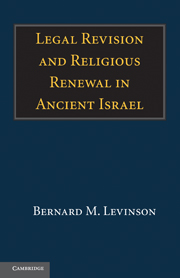
About a year and a half ago, I reviewed Bernard Levinson's book Legal Revision and Religious Renewal in Ancient Israel. I'm pleased to announce that this thought-provoking volume is now available in an affordable paperback edition. My hope is that it will reach a wider audience in biblical studies, especially graduate students interested in the formation of the Hebrew Bible and inner-biblical exegesis. Here are some of the published reactions highlighted by the publisher.
"This would be an excellent addition to any theological library and it is to be hoped that the publisher will soon release a paperback version so more students can enjoy the fruits of Levinson’s labours. —Theological Book Review 21 (2009)
“With this study Levinson demonstrates again how he masterfully integrates his own exegetical brilliance into larger theoretical frameworks beyond the constraints of biblical studies.” —Journal of Ancient Judaism
“The book deserves a wide readership. It would serve well as a text for advanced undergraduate or graduate courses that deal with inner-biblical exegesis. One can also hope that scholars in other fields will read it and take to heart Levinson’s argument for the reintegration of biblical studies into the core of academic work in the humanities. The book’s research is thorough, its argument forceful, its writing elegant, and it is blessedly short. If books can be placed into tribes, may this one’s increase.”—Review of Biblical Literature
“Perhaps I am biased, but it seems to me to be beyond any reasonable doubt that, behind the final form of the canonical, biblical text lies evidence of a lively, imaginative, and creative use of interpretation, reinterpretation, and reapplication of earlier texts. It is a complex, living, creative achievement which, for just this reason, invites constant, continuing invention, as Levinson maintains. I certainly find this book itself a delightful, informative, and stimulating one to read.” —Journal of Theological Studies

Sunday, September 5, 2010

Athas has Meagre Powers

George Athas has entered the biblioblogosphere with his new blog "With Meagre Powers." His introductory post is up and he plans to blog on "biblical studies, theology, Hebrew, and the Ancient Near East."

For those who are asking "who's George Athas", he's teaches Hebrew and Old Testament at Moore Theological College in Sydney, Australia. I knew him first through his book on the Tel Dan inscription. I also had the pleasure of meeting him last fall in New Orleans during SBL.

Welcome to the biblioblogosphere, George!

Monday, August 23, 2010

Daniel in Ezekiel 14: Part 1

Last week, we tackled the topic of whether a biblical writer’s reference to a biblical character from another book was historical or literary. Ezekiel 14 happens to be a classic case for such references in the Hebrew Bible, and my focus last time was mostly on the character of Job.

This time I want to open the discussion about the reference to “Daniel” in the same verses, Ezek 14:14 & 20.
Ezekiel 14:14 (ESV)
even if these three men, Noah, Daniel, and Job, were in it, they would deliver but their own lives by their righteousness, declares the Lord God.
Ezekiel 14:20 (ESV)
even if Noah, Daniel, and Job were in it, as I live, declares the Lord God, they would deliver neither son nor daughter. They would deliver but their own lives by their righteousness.
Is this a reference to the biblical Daniel known from the book bearing his name? It seems unlikely to me for two reasons. First, the name is spelled differently – Daniel in Hebrew is דָּנִיֵּאל. In Ezek 14, the name is spelled דָּנִאֵל. Now in the unlikely event that you don’t read Hebrew, the difference is that one consonant in the middle – yodh. Since the Masoretes were kind enough to point the name in Ezekiel with the same vowels, we read “Daniel” in the Hebrew text which makes its way into English translations as well. But, the vowels were added to the consonantal text hundreds of years later, so even the vowels are a level of interpretation. The consonants of “Daniel” are DNY’L. The consonants in Ezek 14 are DN’L. (The quote mark indicates the consonant aleph-a guttural often silent in pronunciation.) We can argue about the significance of orthography and provide counter-examples of names with variant spellings, and if there were no other candidate for who Ezekiel might be referencing, they might be compelling.

The second reason requires a little bit of background, but it has to do with the later reference to Daniel in Ezek 28:3 – same name, same spelling – important context – an oracle against the prince of Tyre.
Ezekiel 28:2–3 (ESV)
2 “Son of man, say to the prince of Tyre, Thus says the Lord God: “Because your heart is proud, and you have said, ‘I am a god, I sit in the seat of the gods, in the heart of the seas,’ yet you are but a man, and no god, though you make your heart like the heart of a god— 3 you are indeed wiser than Daniel; no secret is hidden from you;
Why is this context important? Well, what relevance would referencing the biblical Daniel have for the prince of Tyre?

“You are indeed wiser than Daniel.”

“Who’s Daniel?”

“You know, the Jewish sage in Nebuchadnezzar’s court in Babylon.”

“No, didn’t know that. Are you sure you don’t mean Danel from the Tale of Aqhat?”

There’s the bottom line. There is an extra-biblical literary character with the West Semitic name DN’L. He is a key character in the Tale of Aqhat, known from Ugaritic literature. A reference to this character makes sense in Ezekiel 14 in a list of 3 non-Israelite figures.

The issue, of course, is whether this Canaanite literary figure fits the description of Ezekiel for a wise, righteous leader. It is easy to assume that what we know about Dan’ilu (aka Danel or Dnil) from the Tale of Aqhat is the full extent of his legend. From there we can dismiss him as not being specifically “wise” or depicted as particularly righteous (as Dressler 1979, for example) and thus not the referent of Ezekiel.

Consider, however, this excerpt from the Tale of Aqhat that depicts Dan’ilu in the typical role of a wise judge (like Job adjudicating at the city gate; cp. Job 29:7-16).
Dānīʾilu the man of Rapaʾu, the valiant Harnamite man, Arose and sat at the entrance to the (city–)gate, among the leaders (sitting) at the threshing floor. He judged the widow’s case, made decisions regarding the orphan. (Context of Scripture, The ‘Aqhatu Legend, 1.103, 5.3.)
I am still researching this question, but at this point, these two lines of evidence are, in my mind, compelling that Daniel in Ezekiel is the Phoenician character, not the biblical sage.

1. The different spelling of the name in Ezekiel is significant.
2. The Phoenician context of Ezekiel 28 suggests a Canaanite, not Babylonian Jewish, literary reference.

Many scholars have written on this issue with the intent of proving the biblical Daniel is in view here in Ezekiel. What they fail to realize is that all of their arguments calling the connection to Dan’ilu into question do not automatically provide support for a connection to biblical Daniel. Even if the identification of Dan’ilu is incorrect, the connection to Daniel the prophet is not thereby proven. (That reminds me – the Logical Fallacies series is ripe for continuation. The above chain of reasoning bears elements of the burden of proof and false dilemma fallacies. I like to call it the “if-you’re-wrong-then-I’m-right” fallacy. It needs a catchier name though.)

In part 2, I will look further into arguments that Daniel in Ezekiel 14 is a reference to the biblical Daniel. I’m waiting to see Daniel Block’s argument in his commentary which I’m told is persuasive, so I’m keeping an open mind.

References
Dressler, Harold H. P. “The Identification of the Ugaritic Dnil with the Daniel of Ezekiel” Vetus Testamentum 29:2 (1979), 152-161; Hallo, W. W. and K. L. Younger. Context of Scripture vol. 1. Leiden: Brill, 1997; Matthews, Victor H. and Don C. Benjamin. “The Tale of Aqhat” in Old Testament Parallels, 70-79. Paulist Press, 2006; Margalit, Baruch. “Interpreting the Story of Aqht: A Reply to H. H. P. Dressler, VT 29 (1979), pp. 152-61” Vetus Testamentum 30:3 (1980), 361-365.

Monday, August 16, 2010

Terminology Pet-Peeve: Israelites and Jews

The Jews, as a people, come into existence after the return from exile in Babylon in c. 539 BCE. Before that, they are Judahites and Israelites. It's an easy distinction to miss, but there IS a difference. I've heard the ancient Israelites referred to as Jews a few times lately from pulpits (I listen to podcast sermons, not just my local pulpit, so no indirect finger pointing). The "Jews" did not leave Egypt with Moses, conquer Canaan, and establish the kingdom of Israel. (I realize Jewish tradition, esp. the Passover haggadah, links ALL Jews to the experience of Exodus. That's a theological issue, not a historical one.)

After the kingdom splits in two (under Rehoboam, Solomon's inept son), the two kingdoms are Israel and Judah. The inhabitants of the northern kingdom were Israelites, not Jews. The inhabitants of the southern kingdom were Judahites. Both peoples are ancestors of the Jews. After the northern kingdom was taken into exile in 722 BCE, the southern kingdom received a large population bump, so Judah under Hezekiah and the following kings until the exile probably included tribes of Israel and Judah together.

If you're reading Ezra, Nehemiah, Esther, or the New Testament, the people are Jews. If you're reading the books of Samuel, Kings, or most of the prophets, they're not Jews. Better to refer to them as Israelites when unified or in reference to the northern kingdom (Elijah was a northern prophet, for example). Referring to the people of the southern kingdom as "Jews" would be marginally acceptable. For a good discussion of the transition from Israelite to Jew, listen to Michael Satlow's podcast series "From Israelite to Jew" found on his blog or through iTunes.

Saturday, August 14, 2010

Quest for the Historical Adam?

Not long after my previous post on taking biblical characters as historical or literal, James McGrath posted a link (via Facebook) to a BioLogos article by Tremper Longman on the question of whether or not there was a historical Adam. I plan to read Longman's thoughts and watch the video later today. But in the meantime, John Byron on his new to me blog The Biblical World interacted with the question. I agree with him that "The Bible was not written as a science and history book."

So, it's a hot topic - did all the people mentioned in the Bible really exist?

Honorable Mentions: Historical or Literary?

Back in 2008, I wrote a post dealing with the issue of whether the New Testament references to Old Testament characters can be taken as evidence for their historicity. My conclusion was that, in general, the NT writers were referring to the characters known from Jewish literature and not trying to claim historicity. I don’t believe they were concerned with those types of questions. It may have been assumed, but it didn’t matter for their theological point whether Jonah or Job really lived. What mattered was the story and the example it provided.

Before I go any further, I need to clarify that I am not questioning the real historical existence of all biblical characters. I am also not reducing the Bible to the level of pure fiction. T.C. recently questioned that ambiguity in my previous post, so I want to be clear. I believe archaeology provides strong circumstantial evidence for the existence of certain biblical people, like David, for example. The best explanation of the Tel Dan inscription is that it refers to a real Davidic dynasty. Certain biblical characters like Abraham, Moses, Aaron, Joshua, David, and Solomon are central to the story of salvation history. I’m not questioning their existence, even though I can’t prove it definitively.

The issue is whether an “honorable mention” by another biblical writer is a reference to a historical person or a literary figure. The default position seems to be to take the reference historically. Earlier I dealt with NT references to OT characters, but what about OT references to other characters?

A few days ago Jeff posted “Was Job a Real Person?” His answer:  “Of course he was!” with appeal to Ezek 14:14 for confirmation.
I realize that Ezekiel is filled with dream-like imagery, but this message from the Lord (and the rest of the section) certainly confirms to me that they were real individuals. Not that I needed any more convincing.
I’m not criticizing Jeff’s conclusion. It is a valid answer to the question, but I don’t think it’s the only reasonable answer. A commenter on his post also drew in James 5:11 to support Job’s existence and commented how he believed Jonah historical as well for similar reasons. But why jump to conclusions? Why assume the biblical writer meant to allude to a historical personage? As a 21st century reader, do you follow the reference because it’s historical or because you know the literary text that it alludes to? That’s easy . . . you know the text. You know the story.

Let’s look closer at the references in Ezekiel 14:14 (repeated in v. 20).
even if these three men, Noah, Daniel[1], and Job, were in it, they would deliver but their own lives by their righteousness, declares the Lord GOD.
Commentators often take this as a reference to 3 non-Israelite “saints.”[2] The non-Israelite identity is important for the larger theme of general or universal retribution in Ezekiel 14.  The connection of righteousness or virtue with these three is also key. Gen 6:9 reads “These are the generations of Noah. Noah was a righteous man, blameless in his generation. Noah walked with God.” Job 1:1 says “There was a man in the land of Uz whose name was Job, and that man was blameless and upright, one who feared God and turned away from evil.” Noah and Job are clearly held up as ideal paragons of virtue. (More to come on "Daniel.") Their righteousness is known not from history but from literature. Does the point of v. 14 require their stories to have actually happened or does it simply require one knows the story - much like a parable teaches a point?

The details given about Job’s status, wealth and family don’t prove the story is not a parable or folk tale. We don’t know where the land of Uz is. Job is identified by his character, not his patronymic (that is, no “son of SO & SO” to give a family identification). The circumstances of his suffering and restoration have all the ring of the classic West Semitic epics like Aqhat or Kirta. The fact that the reference to “Daniel” is almost certainly to a character from a non-biblical West Semitic epic further strengthens the conclusion that Job and Noah are evoked here for their literary significance, not their historical existence. (Was there a historical Noah and a worldwide flood? Still thinking that through, but I knew you’d ask.)

Acknowledging that some OT characters, like Jonah[3]  and Job, might simply be literary figures with no historical existence in no way undermines the accuracy or inerrancy of the biblical text. The issue is with the reader, not the text. The reader is demanding something of the text it never intended to give. Searching for a historical Job is, in my mind, about as likely to turn up solid results as a quest for the historical Prodigal Son (Luke 15).

Comments and discussion are welcome. My thoughts on this issue are continually in process.

[1] Daniel in this text presents a special problem that I’ll address in another post.
[2] See Leslie C. Allen, Ezekiel 1-19, WBC, and Moshe Greenberg, Ezekiel 1-20, AYB.
[3] Jonah, of course, was known from the historical books - 2 Kgs 14:25. But his literary fame comes from the book of Jonah and his fish story - a story, IMO, borrowing the character of an otherwise little known prophet.

Tuesday, August 3, 2010

Hobbins, Finkelstein, and Khirbet Qeiyafa

After a blogging vacation of 11 days (an eternity for Ancient Hebrew Poetry but due to his move, no doubt), John Hobbins has returned to the blogosphere with a vengeance, posting six positively powerful pieces in a paltry period of perhaps 24 hours.

For my part, I perceived the primary project of John’s four posts posing Khirbet Qeiyafa as a possible problem for Finkelstein and his preposterous posturing on the probability of a puny Israelite polity in the 10th century BCE to be a precise paragon of perspicacity. 

1. Finkelstein on Khirbet Qeiyafa
2. Public building activity in the early monarchic period of a polity named Israel
3. Khirbet Qeiyafa: The Kiss of Death to the David-and-Solomon Naysayers
4. Khirbet Qeiyafa and Finkelstein’s Low Chronology

Here are a few quotes from part 3 that illustrate what’s at stake in this debate and why Khirbet Qeiyafa has proven to be such a key find.
Khirbet Qeiyafa poses a challenge to Israel Finkelstein’s hypothesis that the basic outline of the biblical narrative found in 1 Sam – 1 Kgs 11 is a figment of the imagination of much later writers who manipulated inherited tradition in order to place legendary figures of a distant past in a sequence and a set of historical contexts of their own devising (Finkelstein 2006).

Regardless, how can KQ be reconciled with Finkelstein’s oft-defended revisionist synthesis? Once again, in Finkelstein’s mind, the kingdom of David, the bare historicity of which he does not deny, was a polity with (1) a limited administrative capacity at most, encompassing a territorial domain spanning a few neighboring villages; and (2) a weak capability of force projection, offensive and defensive, relative to neighboring external polities.
If so, one would never have expected to find what Garfinkel and company have found at Khirbet Qeiyafa. KQ, a site by all accounts in the Judean Shephelah, was a massively fortified late Iron I/early Iron IIA settlement with public structures at its heart and on its perimeter.
Finally, the concluding paragraph from part 4. I agree that these finds should put all minimalists to shame, but I’m sure John realizes that Davies, Thompson, Van Seters, and Lemche have proven themselves remarkably resourceful in promoting their puerile premises without regard for proof or the proper presentation of logically sound arguments.
If KQ poses a challenge to Finkelstein’s chief theses, it buries those of the minimalists. Israel in Transition Volume 2, edited by Lester Grabbe with contributions by Philip Davies, Niels Peter Lemche, and John Van Seters, is due to hit the bookstores in September. One cannot help looking forward to its contents with singular anticipation. In my view, the Davies-Lemche-Van Seters-Thompson approach is equivalent to whistling in the dark. They can hope against hope that nothing turns up that discredits their conclusions. I can’t help thinking: it already has.

Sunday, July 25, 2010

The Scapegoat Ritual in Leviticus 16

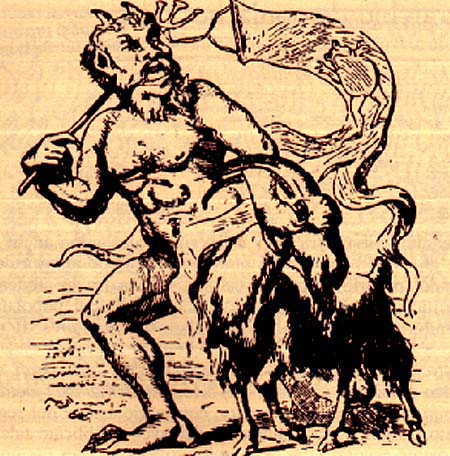
Azazel from Collin de Plancy's Dictionnaire Infernal(Paris,1825).
Leviticus 16 presents the ritual requirements for the Day of Atonement. One of the most enigmatic rituals involves the scapegoat sent off into the wilderness for “Azazel” described in Lev 16:6-10:
6 “Aaron shall offer the bull as a sin offering for himself and shall make atonement for himself and for his house. 7 Then he shall take the two goats and set them before the LORD at the entrance of the tent of meeting. 8 And Aaron shall cast lots over the two goats, one lot for the LORD and the other lot for Azazel. 9 And Aaron shall present the goat on which the lot fell for the LORD and use it as a sin offering, 10 but the goat on which the lot fell for Azazel shall be presented alive before the LORD to make atonement over it, that it may be sent away into the wilderness to Azazel.
There has been much speculation about who or what “Azazel” was: the main interpretations have been a local deity, a wilderness goat-demon, or a desert mountain. Later Jewish literature, notably the Book of Enoch, understood Azazel as a demon, one of the fallen angels and brings him into its complex mythology of supernatural angels and demons.

Rabbinic interpretation understood Azazel to be a cliff off which the goat was driven to its death.
The Rabbis, interpreting "Azazel" as "Azaz" (rugged), and "el" (strong), refer it to the rugged and rough mountain cliff from which the goat was cast down (Yoma 67b; Sifra, Ahare, ii. 2; Targ. Yer. Lev. xiv. 10, and most medieval commentators). Most modern scholars, after having for some time indorsed the old view, have accepted the opinion mysteriously hinted at by Ibn Ezra and expressly stated by Nahmanides to Lev. xvi. 8, that Azazel belongs to the class of "se'irim," goat-like demons, jinn haunting the desert, to which the Israelites were wont to offer sacrifice (Lev. xvii. 7 [A. V. "devils"] (from the Jewish Encyclopedia).
Of course, all of that may be for naught if this Hittite parallel is correct and the term is connected with a type of offering.
“In the Leviticus 16 ritual a crux has always been the term laʿazāʾzēl rendered in the Septuagint and Vulgate by “as a scapegoat” (followed by the English AV), but replaced in more recent English translations by “for Azazel,” sometimes thought to denote a wilderness demon. Appealing to scapegoat rites in the Hurrian language from the Hittite archives, Janowski and Wilhelm would derive the biblical term from a Hurrian offering term, azazḫiya. This is particularly appealing to me. There were two goats used in the Leviticus 16 ritual. One is designated for Yahweh as a “sin offering” (Heb. ḥaṭṭāʾṭ, LXX peri hamartias) (16:9), and the other is “for Azazel,” but is presented alive before Yahweh to make atonement, and is sent away into the wilderness “to/for Azazel.” The contrast is twofold: (1) Yahweh versus Azazel, and (2) sin offering versus Azazel. If one adopts the first, Azazel seems to be a divine being or demon, who must be appeased. But if one adopts the second as primary, the word ʿazāʾzēl represents the goal of the action. In the system of Hurrian offering terms to which Wilhelm’s azazḫiya belongs, the terms represent either a benefit that is sought by the offering (e.g., keldiya “for wellbeing,” cf. Heb. šelāmîm), or the central element offered (e.g., zurgiya “blood”). If Janowski and Wilhelm’s theory is correct, the Hebrew term would not denote a demon as recipient of the goat, but some benefit desired (e.g., removal of the sins and impurities) or the primary method of the offering (e.g. the banishment of the goat).”[1]
Similar rituals are widely attested in the ancient Near East with examples from Ebla and elsewhere. I'm sure much more could be said about the practice and its ancient parallels. Leviticus 16 and the term Azazel provide a fascinating example of how misunderstandings and speculation sometimes spin off into elaborate traditions that fall far from the likely original meaning of the biblical text.

Harry A. Hoffner, Jr., “Hittite-Israelite Cultural Parallels” in Hallo, W. W., & Younger, K. L. (2003). Context of Scripture, vol. 3 (xxxii). Leiden; Boston: Brill.

Saturday, April 24, 2010

The Minnesota Dead Sea Scrolls Exhibit

scrolls-300x250 I had the opportunity a couple of weeks ago to see the Dead Sea Scrolls exhibit at the Science Museum of Minnesota in St. Paul. Last week, I viewed the Dead Sea Scrolls and the Bible exhibit at the Milwaukee Public Museum. Counting my trip to the San Diego exhibit in 2007, I have now had the “once-in-a-lifetime” opportunity to see the scrolls three times. The Minnesota exhibit’s advertising urges you to:
Experience a once-in-a-lifetime opportunity to witness one of the greatest archaeological finds of the 20th century—the Dead Sea Scrolls, which include the earliest known Biblical writings.
I will comment on the Milwaukee exhibit in a separate post. For a much more thorough review than I intend to do, see John’s post here.

If you are in the Twin Cities any time between now and October 24th, I highly recommend you take a few hours to go see the exhibit at the Science Museum. Of the three exhibits I’ve seen, the scope of the MN exhibit is the most comprehensive in terms of background information related to the Scrolls and the site of Qumran. I’m more familiar than the average person with the various theories and debates related to the DSS, and the main thing that impressed me about the MN exhibit was how it laid out all the options related to the identity of the sect and the possible uses of the site without privileging any particular angle. The exhibit does not play up a simplistic either/or dichotomy of Jerusalem origins vs. Qumran Essene origin that might have been assumed from some of the media coverage. While past exhibits have mentioned the existence of multiple theories, this is the only one I’ve seen that incorporates the information on multiple theories throughout the exhibit and doesn’t “spin” the evidence in favor of any particular perspective. (Concerning the San Diego exhibit, Bob Cargill pointed out that his documentary at the exhibit laid out the options. While that may be so, I saw the exhibit but not the movie and the exhibit itself was very much oriented toward the “Standard Hypothesis” of Qumran Essene origin for the scrolls.)

Now I have a theory for why museums and other popular presentations of controversial issues like this present one theory as stronger and more certain than it really is. People like certainty and proof (just ask Scott). They’re uncomfortable with uncertainty, ambiguity, and tension between competing interpretations. They also don’t like to think for themselves. So while multiple theories and raw data might be presented, they’re usually told which one is the “right” answer. Not so at the MN exhibit. All the options are laid out and you’re left to decide for yourself who makes a stronger case. (In case you want someone to tell you what to think: The scrolls were not composed at Qumran by a monk-like group of Essenes. Pick any other theory and it makes more sense of the data.)

The flow of the exhibit works well and the free audio tour was a definite plus. (The Milwaukee exhibit charges an extra $6 for an audio tour which I did not purchase.) Most of your time at the exhibit won’t be spent in the Scrolls room. There are only 5 scrolls on display at a time at the Science Museum. But the Scrolls display is really just the climax to a very comprehensive exhibit of artifacts from Second Temple Judaism and the archaeology of the Dead Sea region. One of my favorite parts of the exhibit was on how Israel is working now to preserve the scroll fragments, contrasting current methods of preservation with the “what-were-they-thinking” techniques from the 1950s (involving scotch tape, plate glass, and cigarettes – you can see the plate glass and the tape still in use on the DSS fragments displayed in Milwaukee).

As an added bonus, 28 pages of the Saint John’s Bible are on display in an additional exhibit at the end of the DSS exhibit. The Saint John’s Bible is a hand-written illuminated Bible, the first of its kind since the invention of the printing press. Scribal culture is getting a mini-revival of sorts! The artwork and script is amazing and well worth seeing.

If you get the opportunity, the Dead Sea Scrolls exhibit at the Science Museum of Minnesota is well worth the trip. It’s a once-in-a-lifetime opportunity!